Cthulhu Mythos
The Colour out of Space — Cthulhu Mythos
A strange meteorite falls on a farm west of Arkham, bringing with it a colour the human eye can scarcely name. At first it makes the land unnaturally fruitful; then, little by little, it ruins the well, the crops, the livestock, and the Gardner family, until only a shunned waste remains.
Article
Summary
West of Arkham lies a blasted patch of land the locals call the grey waste. The trees there are pale and brittle, the well water is unfit to drink, and neither animals nor people willingly go near it. A visiting surveyor hears the old story from an aged farmer named Ammi Pierce and learns that the place once belonged to the Gardner family, before disaster came down in the form of a meteorite. Professors from Miskatonic University came to examine the fallen stone. They found that it held a colour no human being had ever seen before, gave off heat, shrank day by day, and contained strange globular pockets within it. When one of those pockets was broken open, its contents vanished without a sound, as if they were made of no known earthly substance. Later, what remained of the meteorite seeped into the soil with the rain. The following year, the farm produced fruit of impossible size and plants of lurid brilliance, but everything tasted foul and could not be eaten. Then the animals began to sicken and twist, and one by one the Gardners fell into confusion, fear, and bodily decay. The well and the earth seemed to be drained by some unseen colour, and all living things around the house slowly withered. At the end, Ammi and the others saw that inhuman colour rise from the well, carrying with it the last life of the Gardner household and the vitality of the land as it rushed toward the sky. Yet some small part of it seemed to fall back into the depths. The farm became a grey and lifeless waste, and with a reservoir soon planned to drown the valley, the surveyor fears that the colour may be carried farther than anyone can guess.
The Grey Waste
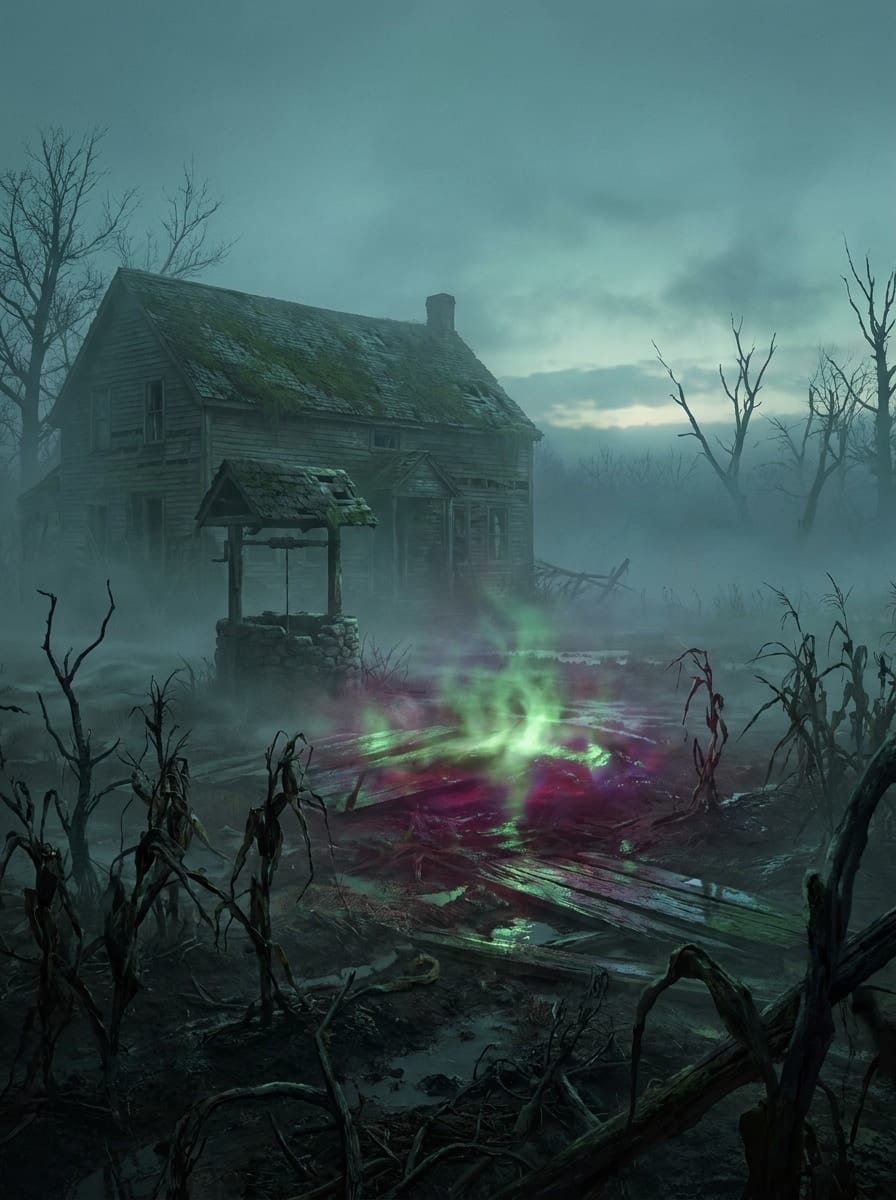
West of Arkham, among the low hills and hollows, there is a place that no one likes to look at for long. Good grass will not grow there. The tree trunks lean crookedly, their leaves thin and sickly, and the soil is neither honest black earth nor yellow clay, but the colour of dead ash. Travellers will go out of their way rather than cross it. Birds seldom settle there, and even rabbits avoid the grass.
In later years the city planned to build a reservoir in that country. A surveyor came into the hills with maps and instruments, marking valleys, brooks, and old roads. He was told that when the reservoir was finished, that strange patch of ground would sink beneath the water; the old well, the ruined house, and the grey soil would all be covered. Yet this only made him more curious. Why did the local people lower their voices whenever they spoke of the place?
He asked many people, but their answers were vague. Some said the ground was unclean. Others said their parents and grandparents had forbidden children to go near it. Some merely waved him away and told him not to ask. At last he found a very old man named Ammi Pierce, who lived not far from the waste. His face was deeply lined, but his eyes were still clear. At first he was reluctant to speak. Then, seeing that the surveyor truly had work to do in that district, he slowly began to tell what had happened long ago.
"Back then," said Ammi, "it wasn't a waste at all. It was Nahum Gardner's farm."
Fire in the Field
The Gardner family lived below the hillside. In front of the house stood a well, with the yard around it; beyond the yard were fruit trees and vegetable plots, and farther off lay the pasture and the tilled fields. Nahum was a hard-working man, and his wife and three children often helped him on the land. That year, toward the end of spring, the air was heavy and close, and at night the clouds hung low over the hills.
One evening the sky suddenly flared. It was not a flash of lightning, gone in an instant, but more like a ball of fire dragging light behind it as it fell from above. Then a heavy crash shook the hillside, rattling the dishes in the house. The Gardners ran outside and saw smoke rising from the field. The earth had been smashed open, and at the bottom of the pit lay a black, shining stone. It was far hotter than ordinary rock, and the grass around it had curled and scorched.
Word soon reached Arkham. The next day several professors from Miskatonic University came to inspect it. They brought hammers, tongs, and glass vessels, and chipped a small sample from the meteorite. The substance was bewildering. It looked like stone, but it was strangely soft. In a glass container it seemed to keep shrinking. It would not cool, and even its weight was hard to judge. The professors tested it in every way they knew, and every test left them more perplexed.
Strangest of all was the colour. In the surface of the meteorite and in its broken edges there was a light no one could describe. It was not red, nor blue, nor violet. People could only call it a colour, yet no flower, mineral, flame, or sunset on earth could be compared with it. Stare at it too long and the eyes began to ache, while the mind felt subtly wrong.
Later the professors returned to the field. The meteorite had already grown smaller than it had been the day before, as if the air itself were eating it away. Inside it was a round cavity filled with that uncanny colour. Someone struck it open with a hammer. Whatever had been inside did not burst, spill, or smoke; it simply vanished without a sound. After the thunderstorm that followed, the stone in the pit shrank still further, until at last it had almost wholly disappeared into the mud, as though it had never truly belonged to this world.
A Harvest Too Rich
At first the Gardner family did not feel that disaster had reached their door. On the contrary, the fields grew with astonishing force that year. Apples swelled larger and more numerous than anyone remembered. The corn stalks rose absurdly high. Melons and other fruits gleamed with colours too vivid to be wholesome. From a distance, the whole farm seemed flooded with fertility.
But when the produce was picked and tasted, people recoiled. The flesh of the fruit had none of its proper sweetness; instead it was bitter, rancid, and corrupt. The leaves in the vegetable patch grew broad and lush, but they could not be eaten. The grass in the pasture looked thick and healthy, yet the animals that grazed on it became restless and uneasy. The eyes of the cattle and sheep grew fixed and dull, and strange ailments began to show in their bodies.
Then the well water changed. The well had once been cool and sweet, but now an indefinable sheen often lay on its surface, especially at night. Anyone who leaned over it felt that some colour was stirring far below. Nahum still drew water from it, because the family could not live without it, and because he refused to believe that a stone fallen from the sky could ruin an entire farm.
The nearby trees changed next. In spring their shoots came quickly, too quickly, and the leaves had an unnatural gloss. When the night wind moved through them, the treetops glimmered faintly in the moonless dark. In the deepest hours, along the furrows, by the well-mouth, and under the fruit trees, there seemed to drift a pale, unfamiliar colour. It was not lamplight, nor the glow of fireflies. It was something seeping out of the earth, the roots, and the water.
Ammi Pierce often came to visit Nahum. He saw his old friend growing quieter and more withdrawn, and urged him to leave the place. Nahum shook his head. His land, his house, his animals, and the life his family had known for generations were all there. He could not bear to abandon them, and he had no money with which to go easily elsewhere. Worse still, the ruin came slowly, so slowly that each day seemed just barely endurable.
One by One, the People in the House Changed
Nahum's wife was the first to break. She grew dazed and distant, staring for long stretches out the window or toward the well. Sometimes she said she heard things. At other times she screamed and tried to hide from presences no one else could see. When her family asked what frightened her, she could not explain. She only said that the colour was coming closer, that the colour was in the house.
Nahum put her in an upstairs room and locked the door, keeping the children away. It was not that he did not pity her; he simply no longer knew what else to do. She paced inside, clawed at the door, and muttered to herself. In time her voice sounded less and less like the woman she had been. When Ammi came to visit, he heard indistinct movements from above, like feet dragging across the floorboards, or fingernails moving along the wall.
The children, too, were gradually overtaken. The youngest, after playing by the well and in the fields, became dull and vacant, and then fell ill. Another child went out to look after the animals and returned grey-faced, as if he had seen something that should never be seen. The cows, horses, chickens, and ducks weakened one after another. Their coats and feathers lost their colour, their bodies warped, and even their deaths seemed unnatural. Nahum himself grew thinner and thinner, with the look of a man being hollowed out from within, yet he stubbornly remained in the house.
By harvest time the farm could hardly be called a farm at all. Fruit rotted on the branches. The grass turned grey. Leaves curled and shrivelled. At night, the colour from the stars rose out of the well and moved across the ground and among the treetops. It did not shine like ordinary light, yet it made the darkness itself seem tainted. Those inside the house heard movements outside, while whatever was outside seemed to be listening to the breathing of those within.
The Last Night by the Well
One day Ammi realized that no word had come from the Gardner place for too long, and anxiety drove him there with others. The yard was utterly still. There were no children's footsteps at the door, and no natural sounds from the barns. Inside the house the air was stale and heavy, as though no window had been opened in a long time.
They found Nahum's wife upstairs. She could no longer truly be called the woman she had once been; disease and that invisible force had tormented her body beyond recognition. Another child was there as well, in a condition just as dreadful. The men were horrified, but they still had to find Nahum. At last they discovered him downstairs.
Nahum was still alive, but he looked as if ash had settled over his whole body. His speech came in broken fragments. He could no longer keep the days straight, but he kept speaking of the well, the light, the children, and the thing that had come from the sky. He seemed to understand that the calamity was no ordinary poison and no common plague, but a living force left behind by the meteorite. It had entered the soil, the water, and their bodies.
After night fell, the glow at the well-mouth grew clearer. The colour rose from the depths like smoke, or like water without shape. Trees, grass blades, roof tiles, and stone walls were all washed in that alien radiance. The men who had come to help stumbled backward in terror. Some fell; others shouted that they must get away. The light did not pursue them, yet it gave each man the sickening feeling that he had already been seen.
At last the mass of colour surged up from the well and streamed toward the sky. It moved with a slow and terrible strength, as if it had drawn all it needed from the land and was finally returning to the spaces between the stars. But as it departed, Ammi saw that a small portion of the light had failed to leave. Like the root of an illness left in the flesh, it sank back into the well and into the deep earth.
The Place Left Beneath the Water
The Gardner family was destroyed. The house was abandoned, and the fields could never be farmed again. From then on the place became the grey waste, where plants would not grow properly, trees leaned deformed, and animals kept away. Some who passed at night from a distance said they could still see a faint, alien colour near the well. Others said that frightened people imagine such things for themselves. The locals did not argue about it. They simply did not go there.
When Ammi Pierce finished his tale, he was exhausted. He did not sound like a man inventing a frightening legend, nor like one embellishing an old misfortune. He was merely remembering how that household had failed day by day, how the fruit in the fields had grown beautiful in the wrong way, and how the nameless colour had risen from the well toward the sky, leaving a trace behind under the ground.
The surveyor later completed his work. The reservoir would be built as planned. Water would fill the valley, covering the well and the grey land. People in the city might drink from it one day, and perhaps no one would hear the name of the Gardner family again.
But those who knew the old story understood that covering a thing with water is not the same as making it vanish. The waste had only fallen silent, like a wound forced shut, waiting beneath the waters of the future.