Cthulhu Mythos
The Case of Charles Dexter Ward — Cthulhu Mythos
Charles Dexter Ward becomes obsessed with the old papers of his ancestor Joseph Curwen and, following a trail of bloodline and sorcery, brings back into the world a man who ought to have vanished forever. By the time his doctor and family understand the truth, the young man's identity has already been stolen, leaving behind a horror that must be ended underground.
Article
Summary
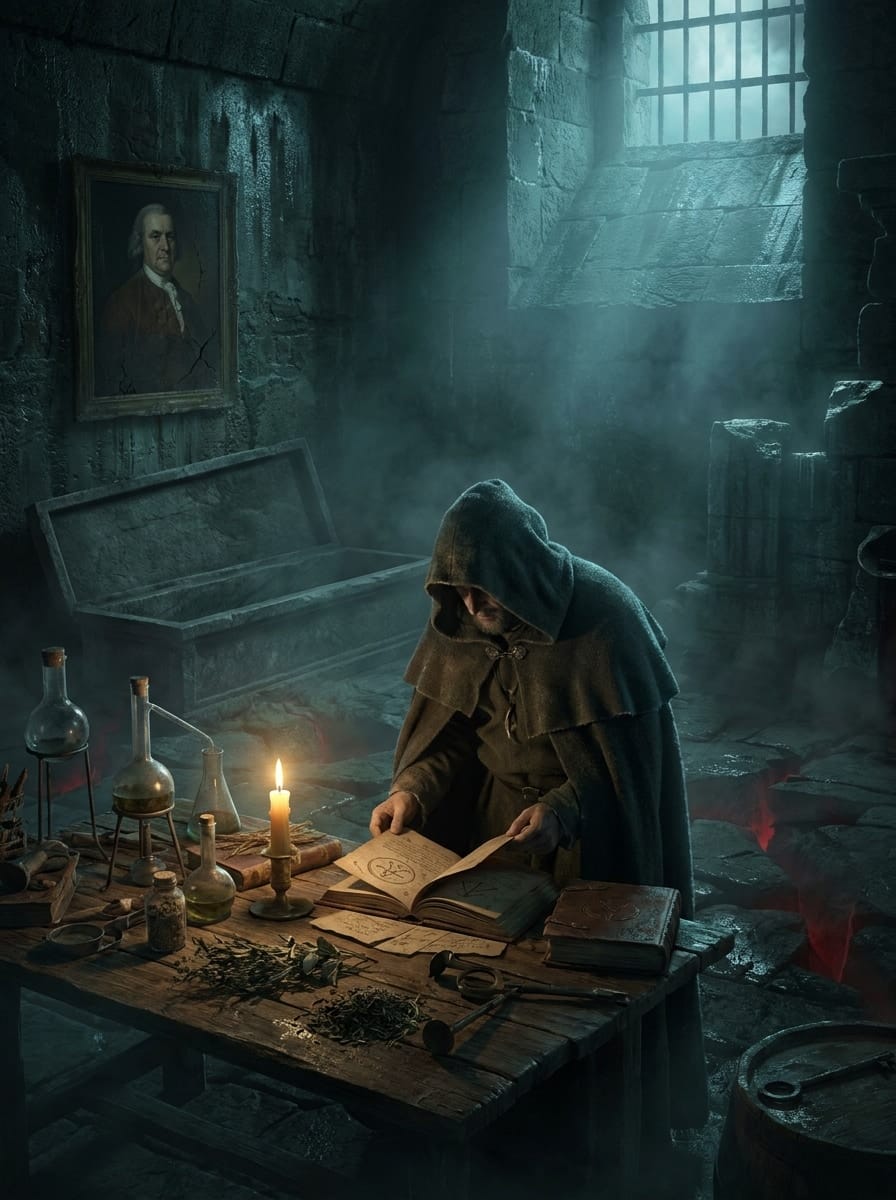
Charles Dexter Ward is born into a respectable Providence family and grows up fascinated by old books, old letters, and family archives. In a portrait and a cache of long-buried documents, he discovers that he bears an uncanny likeness to his ill-famed eighteenth-century ancestor, Joseph Curwen, a man once feared by his neighbors for secret experiments, nocturnal visitors, and rumors from the graveyards. Ward follows the trail ever deeper, finding Curwen's letters, formulae, and traces of an old house. He begins to rebuild his ancestor's research, moving about in secluded buildings and corresponding or speaking at night with people whose identities are unclear. His family thinks at first that he is merely sick with antiquarian obsession, but little by little they notice changes in his voice, his manner, and his eyes. Dr. Willett takes up the investigation and learns that Ward has not merely been studying genealogy. He has uncovered a dreadful method for bringing the dead back in some form. Curwen seems to have used his descendant's body and experiments as a way to re-enter the world, while beneath the old house lie jars, inscriptions, bones, and many beings that should never have been awakened. At last Willett descends into the underground chambers and pieces together the truth of Ward's disappearance and Curwen's return. He understands that the man in the hospital room, though he wears Ward's face, is not the young man at all, but the ancestor come back from the dead. To stop Curwen from continuing to use that body and those forbidden arts, Willett turns the old formulae against him and ends a return that has stretched across two hundred years.
The Young Man Who Loved Old Papers
Charles Dexter Ward was born into an old Providence family. His people were comfortable, and their house held quiet stairways, heavy curtains, old furniture, and many papers no one had closely examined for years. Other children liked to run in the streets; Charles often sat indoors, spreading yellowed letters, family records, and scraps of local history before him page by page.
He had an almost stubborn love of the past. He wanted to know what a street had once been called, which family had moved away in what year, why the windows of a certain old house had been bricked up. At first the adults around him thought him odd, but not in any alarming way. A young man who loved reading and careful inquiry seemed preferable to one who went looking for trouble.
Yet Charles gradually lost interest in ordinary old gossip. He began to pursue the names in his own family line that others had passed over lightly. Some of them appeared faintly in the genealogies, as though later generations had preferred not to say too much. One name, at last, caught hold of him and would not let go.
That name was Joseph Curwen.
Curwen had come to Providence long ago from the Salem region. He was a merchant of means, well housed and well supplied; he bought land, built property, and did business much like other wealthy men. But the tales left behind by old townspeople said that he rarely spoke of his origins, that carriages came and went from his house deep in the night, that strange smells rose from his cellars, and that footprints sometimes appeared in distant graveyards at hours when no living visitor should have been there.
Charles searched more and more deeply. Then he found an old portrait. The man in it wore clothes from another age. His face was pale; his gaze was cold and keen. Charles stood before the painting and felt as if he had been pinned in place.
The face in the portrait was almost his own.
Joseph Curwen's Old Shadow
When Charles told his parents, excitement trembled in his voice. They were astonished at first, but they preferred to think of it as an accidental recurrence of family features. It was not impossible for people separated by generations to resemble one another.
Charles, however, would not stop. He began hunting down every letter, account book, court record, and private note connected with Curwen. He found traces of Curwen's dwelling, and he found many things no ordinary merchant should have left behind.
Curwen had once corresponded with people in distant places. The letters contained ciphers, Latin, Hebrew, and names deliberately obscured. They did not read like business correspondence. They seemed more like the cautious exchange of dangerous secrets. The writers spoke of things underground, of graves, of preserving certain "essential matters" with salts and ashes.
Charles became enthralled. He no longer wanted merely to know what his ancestor had done; he wanted to know how his ancestor had done it. He shut himself in his room for long hours, his desk heaped with dictionaries, copies, and brittle old sheets. Late at night a light still burned there. When his family passed the door, they sometimes heard him murmuring unfamiliar syllables.
His father began to worry. His mother noticed the change even sooner. Charles had always been gentle and courteous; solitary, perhaps, but not gloomy. Now he spoke less and less, and when he looked at people his eyes seemed veiled by mist. At times he stopped abruptly, as if listening to a far-off voice that no one else could hear.
The family called in Dr. Marinus Bicknell Willett. Willett had known Charles since boyhood and knew the young man was not naturally mad. He did not rush to judgment. Instead he spoke with Charles patiently, asking what he had been reading, whom he had met, and why he looked so exhausted.
Charles remained outwardly calm. He said he was only studying family history. He admitted that Joseph Curwen was an interesting figure, but whenever the doctor asked about the letters, formulae, or nocturnal experiments, he fell silent.
When Dr. Willett left the Ward house, he was deeply uneasy. This was no ordinary fascination with old times. Charles seemed caught by a thread that had risen from underground, drawing him farther and farther down while he still believed he was only seeking an ancestral secret.
The Old House and the New Voice
Charles later obtained more secret documents. They convinced him that Joseph Curwen had not died as ordinary people die. Curwen and his associates had studied a dreadful art: the calling up of the dead, in some fashion, from human remains and residual salts, so that they might answer questions and speak secrets buried by time.
Perhaps Charles was shocked at first; perhaps he was even afraid. But before long the knowledge had enchanted him. To a man who had spent his life chasing the past, nothing could be more tempting than making the past speak for itself. Archives could be incomplete, stones could weather, and memory could warp through generations. But if the dead could be summoned, ancient secrets would no longer have to be guessed at.
He began to prepare experiments.
His family noticed that he went out often and returned with mud on his clothes. Sometimes he brought back tightly wrapped little boxes; sometimes he purchased strange supplies from druggists and chemical dealers. He said these were materials for research, but his weariness deepened, and sharp odors often lingered in his room.
Later Charles spent more and more time away from home, in a secluded place where old buildings stood above underground chambers. By day it looked like no more than a desolate property. By night light leaked through cracks and seams like eyes buried in the earth.
People nearby sometimes heard low sounds from within. At times it was like argument; at times like chanting; at other times like some trapped thing knocking far away. Charles came home less often, and when he did, he seemed altered. Powder clung to his fingers, damp earth-smell hung about his sleeves, and now and then some strange archaic word slipped into his speech.
What most troubled Dr. Willett was Charles's face.
The young man had always resembled the portrait of Joseph Curwen, but from a certain day onward the likeness no longer felt accidental. Charles's expression grew heavier, his movements cautious and practiced, and in his eyes appeared a coldness that did not belong to a man in his twenties. He seemed to be imitating a man long dead, or else that dead man was slowly waking through his features.
The Ancestor Who Returned
At last Charles accomplished what he should never have attempted.
Following the directions in the old papers, he used relics from graves, chemical preparations, and uncanny words to summon Joseph Curwen back. But Curwen was no obedient shadow, no ghost brought up merely to answer a descendant's questions. He returned with his own memory, ambition, and cold patience, reaching from death back into the world.
Charles had imagined he could control his ancestor. But he was only a young man seduced by knowledge, while Curwen had mastered those arts more than a century before. One was eager; the other was cunning and seasoned. One thought he was researching history; the other had long been prepared to use bloodline and likeness as a road back into life.
Curwen needed Charles. The descendant looked like him, and possessed a legal identity, family ties, and a ready-made place in society. If Charles could be made to disappear quietly enough, Curwen could put on his name and continue the old experiments in a new century.
After that, the "Charles" seen by the Ward family grew stranger and stranger.
He no longer cared for the old city lore he had once loved. Instead he kept asking after remote places and ancient graves. His speech sometimes betrayed habits that did not belong to the time, as if modern life were unfamiliar to him. He would call people or streets by names from a hundred years before, then hurriedly correct himself when others looked puzzled.
His parents were terrified, yet could not explain what had happened to their son. Dr. Willett watched carefully, and his suspicions deepened. The man before him had Charles's face, but lacked Charles's warmth and memories. Worse still, he seemed to be studying how to perform the part of Charles.
Soon the matter could no longer be hidden. This "Charles" was sent to a hospital. Outsiders believed he had lost his mind, and his family could offer no better explanation. But Dr. Willett refused to dismiss everything as insanity. He knew the real Charles might have left some trace behind, and that the man in the hospital room might not be Charles at all.
The Doctor Goes Underground
Dr. Willett began to investigate alone. He examined the papers Charles had left behind, searching for hidden letters and signs. He visited the old property, noticed entrances masked with fresh earth, and studied marks on the walls that should not have been there. Every clue led him deeper.
At last he found the entrance to the underground chambers.
Below, the air was cold and wet, mingled with the smells of chemicals, soil, and corruption. The doctor carried his lamp forward over uneven ground. Old bricks lined the walls, interrupted here and there by newer repairs. The farther he went, the more the earth seemed to swallow every human sound, until even his own breathing felt alien.
The cellar held jars, books, furnaces, and many instruments whose purpose was hard to name. Other things had been carefully sealed away, like experimental materials or fragments taken from tombs. Looking at that apparatus, Dr. Willett finally understood that Curwen's old research had never truly ended. Charles had merely opened the door again, and behind it stood the dead, long waiting for resurrection.
He found signs more terrible still. Summonings had been performed there, and things called up had been forced to answer. Certain traces suggested that those who were raised were not always ordinary dead men. Some presences were older and stranger than the human mind could comfortably imagine. The doctor had no time to dwell on it. He knew that if he stayed too long, he might never get out.
In a hidden place, he found the evidence left by the true Charles. It was not an intact body, nor anything that could be saved, but it was enough to reveal the brutal truth: young Charles had been murdered by his own ancestor. Curwen had not possessed him. He had used resemblance and identity to replace him.
Dr. Willett fled the underground place in fear. He could not tell everyone the full truth, for they would only think him mad as well. But he now knew that the "Charles" in the hospital must be stopped.
The Old Man in the Hospital Room
When Dr. Willett returned to the hospital, he faced an ancient villain wearing the appearance of a young man.
The figure sat in the room, gaunt and calm, yet his eyes measured the doctor as an obstacle to be used or destroyed. He still tried to preserve Charles's identity, but Willett no longer trusted the surface. As they spoke, the air in the room tightened little by little.
Dr. Willett had brought with him the knowledge he had found underground. He was no sorcerer, and he had no desire to master such arts. But to end the affair, he had to use the countermeasure he had pieced together from those documents.
Curwen understood at last that the doctor knew too much. His disguise slackened, and the old manner came out through his voice. He no longer sounded like a confused patient, but like the man who had once conducted secret experiments in Providence and filled his neighbors with dread.
There were no swords in that room, no thunderous clash. The true struggle took place in words spoken low. Dr. Willett followed the method he had found and uttered the phrases that could return the revenant to dust. Curwen's face changed. He tried to resist, tried to overpower the doctor with the ancient arts he knew so well, but this time the unprepared man was not his opponent.
The borrowed identity began to break apart.
When it was over, Joseph Curwen was no longer in the room, and neither was Charles Dexter Ward. The young man had already died inside the secret he had opened, and the ancestor who had returned from the grave was forced back into the darkness from which he had escaped.
Outsiders knew only that Charles Dexter Ward's strange illness had ended in an inexplicable way. His family received not the return of their son, but a deeper silence after the truth. Dr. Willett preserved enough evidence, and buried still more that could not safely be spoken.
The old streets of Providence remained, and the windows of the old houses still darkened in the night. The opened papers, the disturbed graves, and the marks beneath the earth reminded the few who knew the truth: some ancestors should not be pursued, and some names of the dead are best left forever under dust.