Cthulhu Mythos
At the Mountains of Madness — Cthulhu Mythos
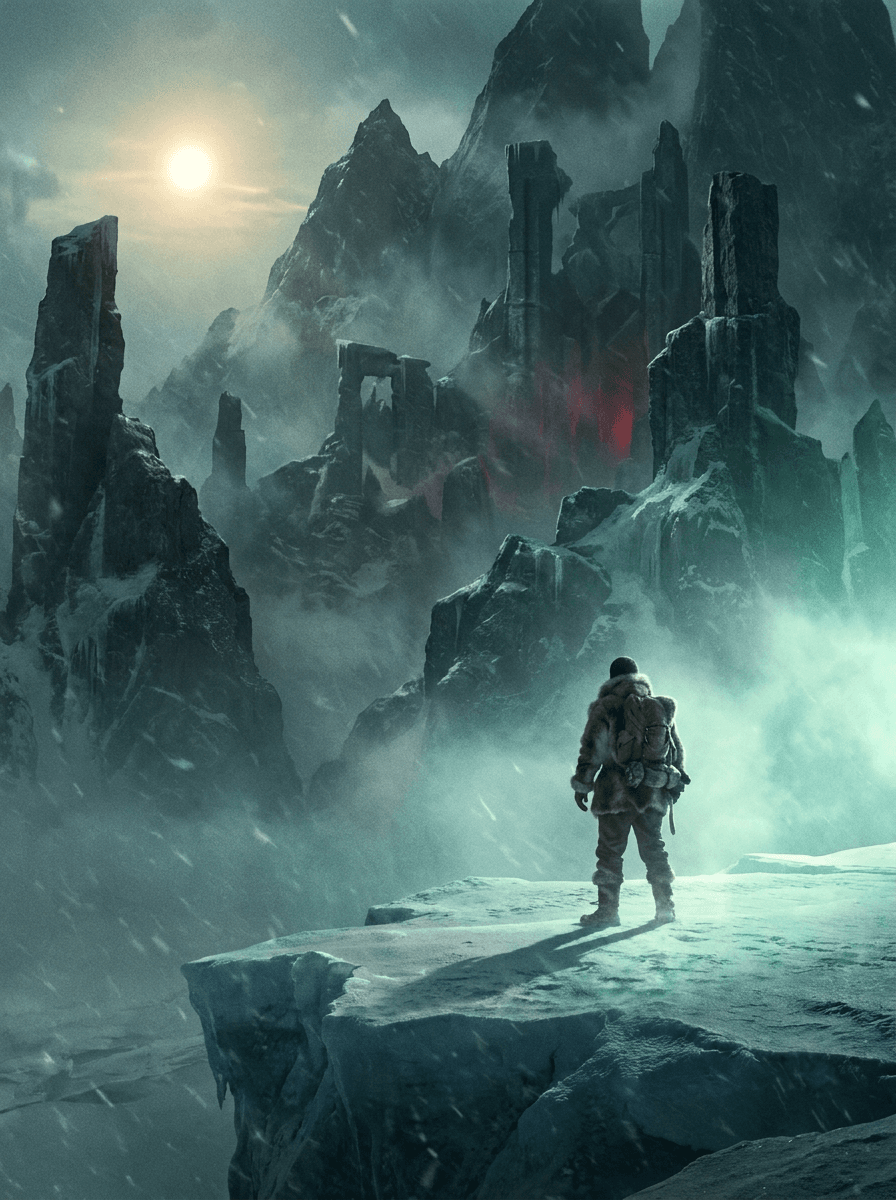
An Antarctic expedition from Miskatonic University discovers, deep in the ice, a range of mountains too high and strange to seem earthly. Beyond them lies an ancient city. The explorers read the traces left by the Elder Things and glimpse the deeper horror those beings once sealed away. In the end, they can only flee back to the human world and warn all who come after never to go there again.
Article
Summary
Miskatonic University's Antarctic expedition begins as a scientific survey. Professor Dyer leads the party across the ice, drilling for samples, until Lake's advance group discovers a staggeringly high black mountain range farther inland and excavates strange, well-preserved bodies from the rock. These specimens are not ordinary fossils, and the sled dogs react to them with violent terror. After a storm, Lake's camp falls silent. When Dyer reaches it, he finds ruined tents, dead men, dead dogs, and missing specimens. Many of the marks cannot be explained by weather or animals. They seem instead to suggest that the ancient beings dug from the earth had awakened and treated the humans as unfamiliar specimens. Dyer and Danforth fly over the mountains and discover, beyond them, an ancient stone city buried under snow and ice. Its carved walls tell how the Elder Things came from the stars, built cities on Earth, created servile life-forms, and were finally undone by their own creations. The more the two men read, the more they understand that human civilization is only a late and brief arrival upon that continent. Deep within the city, they find signs of their companions' deaths, and then evidence that the Elder Things themselves have been torn apart by something still more dreadful. That underground thing is still active, and its sound draws nearer from the dark passages. The two men escape to their plane, but Danforth looks back from the air and is nearly broken by what he sees. Dyer writes his account for one reason only: to stop any new expedition from entering those mountains.
The Expedition on the Ice
When the Antarctic expedition from Miskatonic University set out, none of its members imagined that the journey would become a nightmare.
They were professors, graduate students, pilots, and mechanics, carrying drills, tents, wireless sets, cameras, aircraft, and crate after crate of instruments from familiar cities into the dazzling white of the southern continent. There were no trees there, no birdsong, only wind scraping across the ice like the back of a knife drawn close to the ear. The sun wheeled low in the sky, night came in strange ways, and the cold did not creep in like a northern winter. It entered all at once through boot soles, glove seams, and every breath.
Professor Dyer, the leader of the expedition, was chiefly a geologist. His mind was on strata, fossils, and the early marks of Earth's history. The party made camp upon the ice, used airplanes to move men and supplies, set up their drills, and drew samples from deep below. For many days their findings were ordinary enough: ancient stone, traces of coal seams, impressions of creatures long extinct. Each object could be written into a report; each measurement could be entered in a table.
Then Professor Lake led a smaller party northwest, and matters began to change.
Lake's excited voice came over the wireless. He said they had found a tremendous line of mountains, higher by far than any polar peaks known to them, their walls rising behind the ice like black blades, their summits vanishing and reappearing in cloud and wind. He also said that nearby strata had yielded peculiar fossils, neither ordinary plant nor ordinary animal, and complex enough in form to trouble the eye.
At the main camp, the others gathered around the wireless to listen. At first they were delighted, thinking this might be a discovery that would shake the learned world. Lake's words came in broken bursts, but his urgency grew. The things they had dug out possessed barrel-shaped bodies, star-like structures at top and bottom, folds, membranous wings, tubular organs, and many parts whose purpose no one could guess. They were too perfectly preserved to be mere impressions in stone. They seemed more like bodies frozen out of some immeasurably distant age.
Lake said they had moved several specimens into a tent, intending to dissect and photograph them. He added that some of the sled dogs had gone mad at their smell, straining at their ropes and howling, refusing to come near.
By then Dyer felt that something was wrong. But he had not yet imagined that the next day would bring not further reports, but silence.
The Ruined Camp
After the storm passed, the main camp could no longer reach Lake's party.
Only static came over the wireless. Dyer called again and again, asking whether they needed help, whether the planes could still fly, whether there were wounded men. No answer came. At last everyone understood that they would have to go in person.
As the plane crossed the ice, Dyer saw the mountain range in the distance. These were no ordinary mountains. Black peak after black peak stood in a line, high enough to seem to prop up the sky, their steep cliffs showing strange angles in the snow glare. The nearer they came, the clearer it became that the range was not a gentle upheaval of land, but a barrier torn open by some colossal force, shutting the world known to humankind away from what lay beyond.
They landed near Lake's camp.
Everything there was in disorder. Tents had been ripped open, instruments overturned, boxes scattered across the snow. Many of the sled dogs were dead, their bodies piled together in a strange way. The men were dead as well. Some seemed to have been brutally cut open; others had been buried in snowdrifts, with only stiff corners of clothing showing. More chilling still, the strange specimens dug from beneath the earth were gone, and several human bodies were missing too.
Dyer and his companions searched the camp, trying to understand the disaster. Had it been the storm? Had some man gone mad? Had the sled dogs broken loose and killed them? Yet too many traces refused such explanations. The tents had not been torn by wind, and the bodies did not look as if animals had mauled them. Someone seemed to have been making notes before death, but the record stopped suddenly, as though the writer had heard something, looked up, and never bent over the page again.
In one part of the camp they found signs that someone might still be alive: Gedney was gone, and another member of the party had vanished with him. This deepened the survivors' confusion. No one wanted to voice the worst possibility: perhaps the things treated as fossils had not been fossils after all.
Dyer gathered what records he could and buried the dead as best as circumstances allowed. Yet one question remained in him. What lay beyond that mountain range? In his final messages Lake had mentioned strange rock forms, shapes that hinted at artificial structures. Dyer knew that unless he saw for himself, he would never understand what had happened there.
So he and young Danforth took one of the planes and flew toward the depths of the mountains.
The Stone City Beyond the Mountains
The two men spoke hardly at all as they crossed the range.
The plane trembled in the thin, bitter air, and the propeller's sound was torn by the high wind until it seemed to come and go. Peaks rose on either side, with long bands of ice and snow hanging from the black rock walls. Dyer watched the altimeter and saw that the mountains were even more dreadful than he had imagined. They stood like a wall before the deeper secrets of Antarctica, and before a boundary humankind had never been meant to cross.
When they passed over the highest ridge, Danforth suddenly cried out under his breath.
Beyond the mountains there was no empty ice plain.
There was a city.
Most of it lay buried under ice and snow, but its vast outline remained visible. Enormous towers stood crookedly upright. Wall joined wall. Arches, platforms, ramps, and square masses of masonry showed black and gray edges through the white covering. Many of the structures did not follow the straight lines and proportions of human cities. Their angles and measures felt warped and unsettling, as though the builders' bodies, senses of direction, and ways of living had all been utterly unlike our own.
Dyer and Danforth found a comparatively level place to land. They took flashlights, ropes, cameras, and notebooks, then entered the silent stone city.
There were no footsteps in it, no smoke, no sign of living things. Wind poured in through hollow windows and out along far corridors, making a sound like distant murmuring. They passed through broad passages and saw that the walls were covered with relief carvings. After ages beyond imagining, the cold and dryness had preserved many of their details.
At first Dyer took them for ornament. But the farther he went, the more he felt that the carvings formed a history.
The images showed beings with star-shaped heads and barrel-shaped bodies. They had come from the stars to the young Earth and built cities in the sea and upon the land. They could fly and move through water; they raised huge stone dwellings, cut roads, governed territory, and studied life. Slowly Dyer understood that these were the very beings Lake had excavated from beneath the ice: the Elder Things.
That name later seemed to him the safest one to use in his account. They were not the ancestors of humanity, nor gods from human legend. They were inhabitants of Earth far older than humankind, beings that had come from the remote depths of space and possessed cities, crafts, and wars before humans had ever appeared.
Danforth held up the flashlight, its beam wavering over the carvings. They saw the Elder Things at war with other powers from beyond Earth, and saw their cities spread from the sea onto the land. Deeper within, the carvings showed that they had created a servile form of life: a shapeless thing with no fixed skeleton, able to alter itself, made to carry, dig, build, and perform the heaviest labor of the cities.
At first these creations were only tools. Later the images on the walls became confused. The creatures grew, rebelled, devoured, and even learned to imitate. The Elder Things had once suppressed them and driven them back into the deep darkness, but the catastrophe had never truly vanished.
Standing before the cold stone wall, Dyer suddenly remembered certain obscure and dreadful passages in the Necronomicon. What had once seemed the ravings of madmen in old books now had a shadow and a shape within this city.
The Awakened Discovery
Dyer and Danforth went on into the city.
They followed a corridor into a better-preserved district. There were rooms like laboratories, broken tables, and recesses that might once have held specimens or tools. Snow and ice covered the floors, but in some corners they could still see marks of recent disturbance. Dyer knelt to examine them and found damp traces and drag marks that could not have been left millions of years before.
The two men grew quieter with every step.
If the specimens from Lake's camp had truly awakened, where would they have gone? If the Elder Things had stirred again after their long freezing, might they not instinctively return to their own city? Dyer did not dare say this aloud, but Danforth's face showed that he had reached the same thought.
Before long, they found several bodies in a passage.
They were not the bodies of Elder Things, but the remains of missing members of Lake's party. Their clothes and equipment could still be recognized. Fighting down his fear, Dyer examined them and saw that the men appeared to have been inspected, opened, and handled in a manner almost like research. At that moment a more complicated chill rose within him: whatever had killed them had not been a beast. It could observe, analyze, and treat human beings as unknown specimens.
Farther on, they found the bodies of Elder Things.
These were no longer whole. Some had been torn apart; others were covered with a slick residue. A foul odor hung in the passage, and the walls and floor were marked by broad stains where something had dragged itself along. Dyer and Danforth understood at once that something else was in the city. It had not come from Lake's camp with the Elder Things. It was the very calamity the Elder Things themselves had once feared, subdued, and buried.
A sound came from far away.
It was not a human cry, nor the roar of any animal. It seemed to squeeze out of some deep cavern, moist, heavy, and echoing with no shape of throat behind it. Danforth froze where he stood, the flashlight beam shaking violently. Dyer seized his arm and said in a low voice, "Go."
They turned and ran back the way they had come.
The city's passages became a maze around them. Corners they had remembered a little while before now all looked alike. The reliefs on the walls flashed past in the flashlight's beam like countless ancient eyes watching them flee. Ice slipped beneath their feet, packs struck their shoulders, and their breath hammered inside their masks. Behind them the sound drew nearer and then farther away, sometimes like some viscous mass surging along the floor, sometimes like an enormous body forcing itself through a narrow stone doorway.
At last they burst out of the building and into the blinding snowlight. The plane stood in the distance, a thin layer of snow on its body. Dyer all but pushed Danforth into his seat and climbed into the cockpit after him. The engine turned over with a slowness that felt like despair. Only when the propeller finally hurled up a cloud of snow did they lift from the ground.
The plane skimmed above the city walls. Dyer did not dare look back. He kept his eyes on the ridge ahead and on the instruments. But Danforth looked.
What he saw, he could never clearly tell afterward.
He let out one uncontrolled scream, like a man who had suddenly glimpsed the true shape behind the world. The plane lurched violently in the air while Dyer fought the controls and shouted his name. Danforth's face was white, his lips trembling. Broken words came from him, as if he were describing something still deeper beyond the far mountains, or repeating a sound no human being ought to understand.
They crossed the black peaks and escaped back to the camp of men.
The Place No One Must Return To
After returning to camp, Dyer did not at once tell the whole truth.
He knew that if he merely spoke of an ancient city, more people would want to go. If he said there were inexplicable forms of life and danger there, some would take it as a challenge. Science, fame, curiosity, and the rivalry of nations would all drive new parties toward that ice. Human beings see the unknown and try to approach it; they hear a prohibition and long all the more to cross it.
But Dyer had seen the city beyond the mountains. He had seen the history left by the Elder Things, and he had seen what came after their decline. They had once been mighty. They had built upon Earth a civilization almost beyond human imagining. Yet even they had not controlled forever the darkness they created, nor held in check the horror in the depths below.
Lake's party was dead. The awakened Elder Things were dead as well. Snow covered the camp again, and the wind erased human footprints as if everything had been no more than an accident on the Antarctic waste.
Dyer knew it was not.
He wrote his account not to boast of discovery, and not to tempt later explorers to fly the same course. He wrote because news had already come of a new Antarctic plan, with airplanes, drills, and young explorers preparing once more for that continent. All he could do was set down as clearly as possible what he had seen: the black mountains, the city beneath the ice, the ancient history on the walls, and Danforth's collapse after that single backward glance.
He hoped that whoever read it would understand that some places are not blank spaces waiting for human conquest. They are shadows of terror from remote ages, silent for so long that humanity mistakes them for emptiness.
Deep in Antarctica, that mountain range still stands. Wind passes over its ridges, and snow falls in the stone city where no one walks. The walls of the Elder Things still preserve the past in darkness, and in caverns deeper still, perhaps, a sound continues to echo slowly beneath the ice.