Greek Mythology
Hera — Greek Mythology
Queen of Olympus
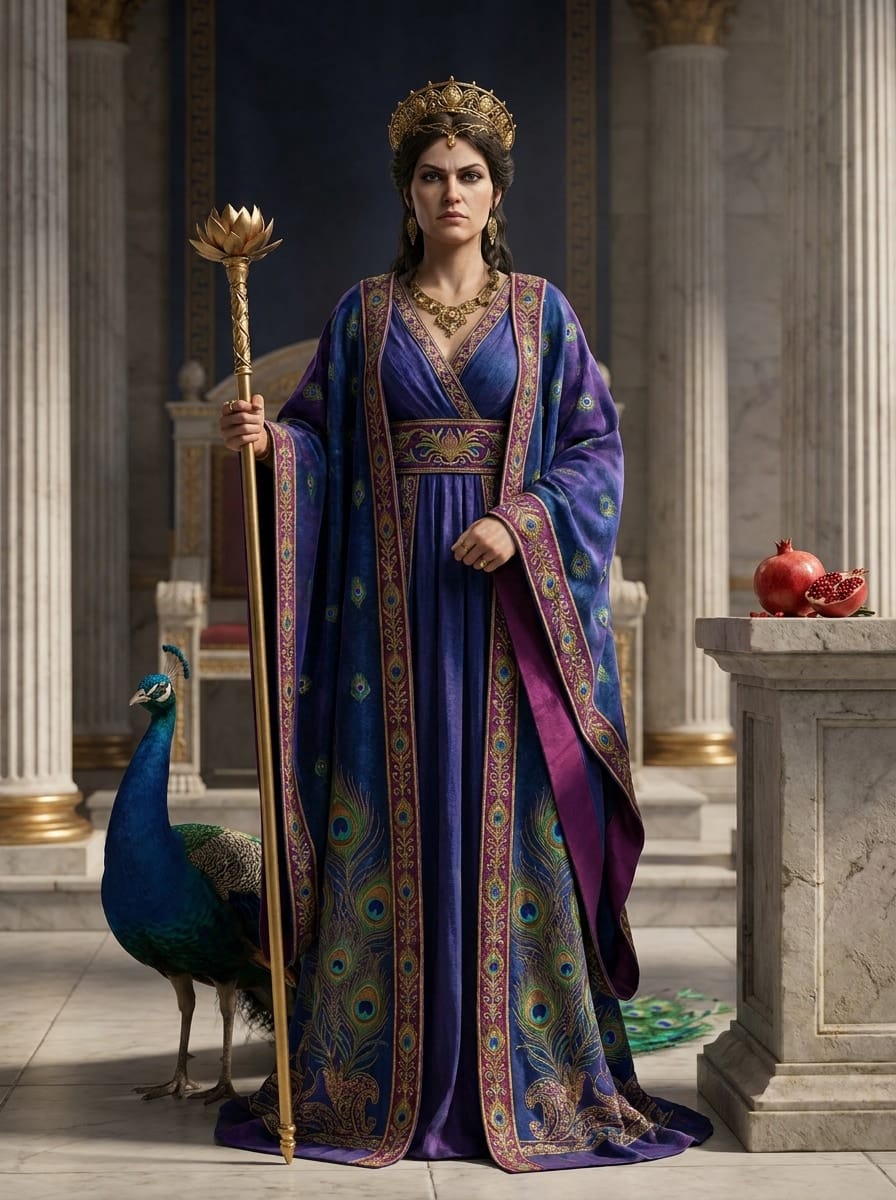
Queen of Olympus, guardian of marriage and royal authority; she sits enthroned as queen of the gods, remembering every broken oath and every slight, and upholds the order she recognizes through delay, reckoning, and punishment.
Domain
Marriage, Kingship, Family, Childbirth
Symbols
Peacock, Pomegranate, Crown, Scepter, Cow
Article
Origin and Lineage
Hera is the daughter of Cronus and Rhea, Zeus’s sister, and also his wife. Among the Olympian gods she holds the place of queen, not merely as a consort but as another pillar in the structure of divine rule. The Hesiodic genealogy places her at the crucial point where the old Titan order collapses and Olympian power takes shape, so she is no marginal ornament. From the beginning, she is bound to rule, legitimacy, and the order of the household.
Divine Roles and Attributes
Hera’s powers often center on marriage, lawful wifehood, kingship, and domestic order. She is not known for charging into battle, but for patience, memory, strategy, and punishment: she can wait for the right moment, and at the decisive point she can push time, birth order, and fate into the position she wants. She is especially sensitive to broken oaths, false identities, transgressive desire, and contempt for the marriage bond, because in her eyes these are not only private moral failures but attacks on order itself.
Major Myths
In this system, the clearest image of Hera comes mainly from the stories of Heracles. Before his birth, she contrives to delay Alcmene’s labor so that Eurystheus is born before Heracles, causing the future hero to fall behind another in status and claim. While Heracles is still in the cradle, she sends two snakes into the house, testing the child and forcing his astonishing strength into the open. Later, when he is grown, she casts madness into his mind, so that in his loss of reason he kills his wife Megara and their children with his own hands. To Hera, these are not scattered acts of revenge but one continuous line: she will make Zeus’s private affairs pay their price, and she will make this newly thrust-forward “son of a god” understand that divine strength does not mean boundaries can be ignored.
Worship and Influence
In the broader Greek tradition, Hera is the goddess of weddings, queens, lawful wifehood, and the order of the household. Her worship and imagery usually carry dignity, authority, and ritual weight: the crown, scepter, peacock, pomegranate, and cow all point to her queenly bearing and her power of abundance. People should not understand her only as a “jealous wife”; that reduces her to gossip. More accurately, she represents the dignity of lawful union, the legitimacy of royal succession, and the public weight that marriage must bear. Whoever treats an oath lightly before her will discover that the queen of the gods does not mistake recklessness for harmlessness.
Character Overview
Seen only through these stories, Hera is a calm and dangerous queen: she remembers for a long time, strikes with precision, can halt a birth, and can make a hero lose the family most precious to him. But she is not merely an emotional obstructer. Her severity comes from rank, dignity, and a long anger at the abuse of order; her revenge always carries an institutional meaning, as if to say: marriage is not decoration, status is not an excuse, and gods and mortals alike must answer for crossing their limits. To understand Hera, one cannot look only at her anger. One must also see why she guards marriage, kingship, and the place of the lawful wife with such stubborn force.