Greek Mythology
Athena — Greek Mythology
Goddess of Wisdom, Battle Strategy, and the City-State
Athena is one of the Twelve Olympians in Greek mythology, governing wisdom, strategy, civic order, handicrafts, and disciplined war. She is the daughter of Zeus and one of the deities who most clearly embodies the power of reason, judgment, and discipline. Unlike Ares, who represents the frenzy of the battlefield, Athena does not glorify uncontrolled slaughter; she stands closer to the lucid, calculating, protective, and restrained side of war.
Domain
Wisdom, strategy, city-states, crafts, defensive war
Symbols
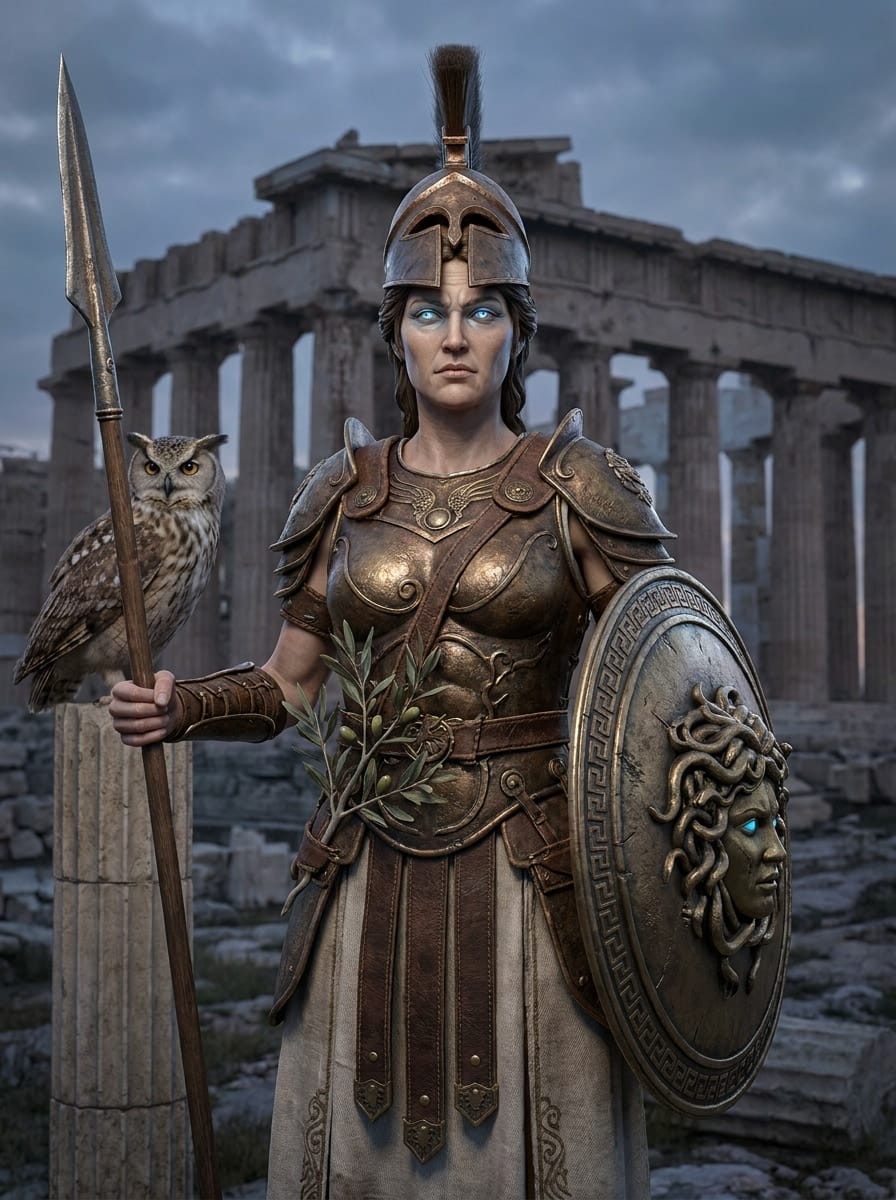
Owl, olive tree, spear, helmet, aegis
Article
Origins and Lineage
Athena’s birth is itself the result of divine power, prophecy, and wisdom intertwined. Zeus married the clever Metis, but heard a prophecy that she would first bear him a daughter, and if she later bore a son, that son would become powerful enough to threaten the throne of the king of the gods. To escape the cycle in which a father is overthrown by his son, Zeus persuaded the changeable Metis to take on a small form and swallowed her into his belly. Metis did not vanish; she retained her wisdom inside Zeus, and the child in her womb continued to grow.
Later, Zeus was struck by a splitting headache, and the gods summoned an axe-bearer to cleave open his skull. Athena did not appear as a helpless infant, but leapt from the opened head fully armed, wearing armor and holding a spear. From the moment of her birth, she linked wisdom, battle formation, and majesty together, and so she is often understood as “the goddess born directly from thought and judgment.”
She is also often called “Pallas Athena.” The origin of “Pallas” is explained in different ways in ancient tradition: some accounts connect it with a companion whom she accidentally killed, while others treat it as an ancient sacred title. Whatever its source, the name strengthens her image as a warrior goddess and protector of the city-state.
Divine Roles and Attributes
Athena’s divine role is not limited to the single word “wisdom.” She represents a kind of wisdom that can enter practical affairs: in war, it appears as strategy, judgment, and discipline; in the city-state, as law, public order, and prudent governance; in daily life, as weaving, crafts, skills, and orderly labor. Her wisdom is not abstract contemplation, but the ability to turn chaos into order and transform power into achievement.
In war, Athena stands in sharp contrast to Ares. Ares symbolizes the charge, bloodshed, rage, and loss of control on the battlefield; Athena symbolizes tactics, organization, restrained courage, and the force that must sometimes be used to protect the city. She does not reject war, but she demands that war be bound by reason and purpose. For this reason, she often stands behind heroes, giving them advice, courage, and the right moment, rather than simply inciting violence.
Her major symbols include the helmet, spear, shield, and the aegis. The aegis often bears the head of a Gorgon, symbolizing both deterrence and protection. The owl is her most famous animal symbol, representing insight in the night, calm observation, and wise judgment. The olive tree is the sacred gift she gave to Athens, symbolizing peace, agriculture, oil, timber, wealth, and long-term prosperity.
Major Myths
Athena’s most famous city myth is the story of her contest with Poseidon for the patronage of Athens. Poseidon struck the earth with his trident, bringing forth seawater, a spring, or horses, displaying his immense natural power; Athena offered the olive tree. The Athenians ultimately chose Athena, because the olive tree brought not a momentary shock, but sustainable life, economy, and civic prosperity. This story expresses more than “Athena defeated Poseidon”; it expresses Athens’ understanding of its own ideal: the lasting order of a city should be built upon wisdom, production, and restraint.
Athena is also a protector of heroes. She helped Perseus slay Medusa, guiding him on how to avoid looking directly at the Gorgon’s deadly gaze; she supported Heracles in completing his difficult labors; and in the Odyssey, she long protected Odysseus, helping him reclaim his home through cunning, endurance, and speech. In these stories, Athena is not the god who completes the hero’s task for him, but the one who teaches the hero how to use his own strength rightly.
In the Iliad, Athena is an important supporter of the Greek side. She intervenes on the battlefield many times, inspiring heroes and also checking reckless action. She once helped Diomedes wound Ares, and in conflicts among the gods she also overpowered Ares. These narratives reveal a value judgment about war in Greek mythology: blind bravery is not reliable; what truly wins wars is wisdom, discipline, and mastery of timing.
She also appears in the Judgment of Paris. Together with Hera and Aphrodite, she competed for the golden apple and promised Paris victory and glory in war; but Paris ultimately chose Aphrodite, leading toward the Trojan War. After that, Athena stood on the side of the Greeks, not only because she had been personally slighted, but also because the Trojan War became, in myth, a vast stage where order, oaths, honor, and destruction were intertwined.
Her severe side is equally important. Arachne, in her arrogance, challenged Athena to a weaving contest and used her work to mock the gods; in the end, she was transformed into a spider. The story of Medusa is also connected with Athena in different traditions: some versions emphasize that Medusa was punished after being violated by Poseidon in Athena’s temple, while others place more emphasis on Athena later setting Medusa’s head upon her shield. Whatever the version, these stories show that Athena is not simply a gentle goddess of wisdom; she protects craft, sacred space, and order, and she also punishes arrogance and sacrilege with severity.
Worship and Influence
Athena’s most important cult center was Athens. As “Athena Polias,” the guardian goddess of the city, she protected the city, the Acropolis, and the community of citizens. The Parthenon on the Acropolis of Athens is one of the most famous monumental buildings associated with her worship, and it closely joins her divinity to Athens’ political identity, artistic achievement, and public glory.
The Panathenaea, dedicated to Athena, was one of Athens’ most important festivals. It included sacrifice, procession, athletic contests, music, and the ritual presentation of a robe, in which people offered the goddess a newly woven sacred garment. This ritual strongly reflects Athena’s many identities: she is both an armed guardian and a goddess of weaving and craft; she belongs both to sacred space and to the public life of the city-state.
Athena’s worship was not limited to Athens. She had sanctuaries and local titles throughout Greece, often appearing as a protector of city defenses, wisdom, skills, or heroes. Different regions emphasized different aspects of her: some valued her military protection, some her craft abilities, and others her majesty as a maiden goddess and goddess of purity.
In later culture, Athena became an enduring symbol of wisdom, reason, strategy, and civilized order. In Roman religion, she was often identified with Minerva. Although Minerva in the Roman context was also associated with wisdom and crafts, the Greek Athena always retained a more distinct image as city protector, strategic goddess, and mentor of heroes.
Character Overview
Athena is not simply a “goddess of wisdom” in the narrow sense. The wisdom she represents is wisdom capable of bearing real pressure: preserving judgment in the face of war, maintaining order in the face of power, pursuing precision in craft, and building structure in the face of chaos. She has both weapons and the loom; she can enter the battlefield and guard the city; she supports heroic ventures, but also demands that heroes learn restraint.
For this reason, Athena has a cool and hard-edged charm in Greek mythology. She does not change the world through desire as Aphrodite does, nor strike the world through violence as Ares does; she is more like the power that makes the world capable of being organized, judged, and protected. She reminds people that true strength is not merely power itself, but knowing when to use power, how to use it, and for what purpose.