Greek Mythology
The Titanomachy — Greek Mythology
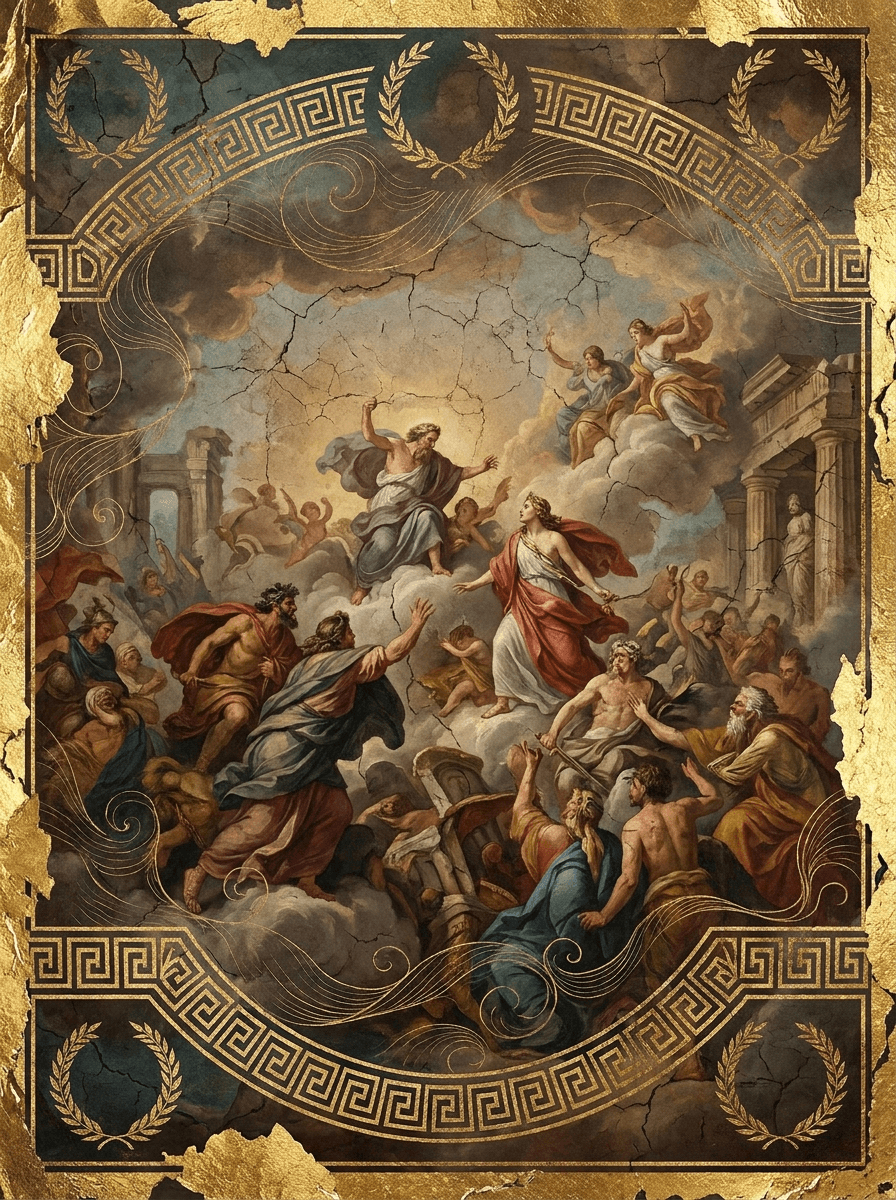
Kronos swallowed his own children to keep his throne as king of the gods. When Zeus grew to manhood, he freed his brothers and sisters, called upon mighty divine beings long held in prison, and waged war against the Titans. After ten years of battle, thunderbolts, hurled stones, and the strength of the Hundred-Handers overwhelmed the old gods. The Titans were shut away in Tartaros, and a new race of gods ascended Olympus.
Article
Summary
Kronos feared that one of his children would overthrow him, so each time Rhea bore a child, he swallowed the newborn whole. At last Rhea saved the youngest, Zeus, hiding him away until he grew strong. When Zeus came of age, he found a way to make Kronos vomit up the children he had swallowed. Poseidon, Hades, Hera, Demeter, and Hestia came back into the light, and the hidden quarrel between the old gods and the new could no longer be contained.
The Children Swallowed
When Kronos sat above the gods, there was no peace in his heart.
He had once overthrown his father Ouranos with a sickle, but he had also heard a prophecy: one day, a child of his own would drive him from power. The words lay on his chest like a cold stone. Each time Rhea bore a child, Kronos reached out, took the infant before its mother could look at it for long, and swallowed it down.
Hestia was swallowed. Demeter was swallowed. Hera was swallowed. Hades and Poseidon were swallowed too. Again and again Rhea gave birth, and again and again she lost her children. There was no crying of infants in the palace, no soft creak of a cradle—only the silence of Kronos, growing heavier and darker.
When the youngest child was near birth, Rhea could bear it no longer. She went to Gaia, goddess of Earth, and to Ouranos, hidden deep away, and begged for counsel. They told her to carry the child to Crete, bear him in a secret cave, and then wrap a stone in swaddling cloths and give it to Kronos in his place.
Rhea did as they advised. After the child was born, she hid him in a deep cave, far from his father’s sight. Then she returned to Kronos with the wrapped stone in her arms. Kronos did not look closely. He feared only that the child might live, that the prophecy might come true; so he opened his mouth and swallowed the bundle whole.
The stone sank into his belly. The true child, meanwhile, grew slowly in the mountain cave of Crete. That child was Zeus.
Zeus Frees His Brothers and Sisters
When Zeus grew up, he was no longer the helpless infant hidden in a cave. He knew that his brothers and sisters were still trapped inside their father, and he knew that Kronos would never surrender his kingship willingly. If anything was to change, the swallowed gods had to be freed first.
In one ancient telling, Zeus found help and made Kronos drink a potion that forced him to vomit. Kronos did not realize that danger had already come close. Once he drank it, his stomach heaved, and at last he brought up, one by one, the children he had swallowed.
The stone came out first—or, in another version, it was the last thing Kronos disgorged. In either case, what he had once swallowed returned to the light of day. Then the long-imprisoned gods emerged as well. They had not died in darkness like mortals. Gods are not easily destroyed; they escaped from their father’s belly still bearing their divine strength.
Hestia, Demeter, Hera, Hades, and Poseidon stood beside Zeus. Once, they had not even been given the chance to cry out. Now at last they could see one another. Kronos looked upon the children who had returned, and he understood that the prophecy had entered his house.
From that moment, the older Titans and the party of Zeus could no longer sit together in peace. Kronos would not yield the throne; Zeus would not return to the cave. War drew near.
Olympus and Othrys
Kronos summoned the Titans who stood with him. They were ancient and powerful gods, born after the first opening of heaven and earth. They had long occupied the heights and were used to seeing the world bend beneath their stride. Many Titans followed Kronos and gathered around the high mountain Othrys.
Zeus and his allies climbed Olympus. Its peaks rose steeply, with clouds coiling around the rock. There the younger gods took counsel on how to withstand the power of their fathers’ generation. Poseidon was fierce by nature, Hades silent and deep; Hera, Demeter, and Hestia also knew that this quarrel could not be settled by a few words.
Not every god joined Kronos. Okeanos, the great river encircling the world, did not give the Titans eager help in the war. More important still, Styx, goddess of the underworld river, came early to Zeus with her children. Among them were divine powers such as Victory, Strength, Force, and Zeal, and they stood beside Zeus on Olympus. Zeus did not forget that first allegiance. Later he made the gods swear by the waters of Styx, giving her one of the highest honors among the immortals.
Yet even with allies, the war was hard.
The Titans were no ordinary enemies. Their bodies were vast, their strength old as the world, and the valleys shook beneath their steps. Zeus and his brothers and sisters were young, but they would not give way. The two sides battled between earth and sky, and thunder, cries, and the crash of blows rang through the heights and the depths.
The war lasted ten years.
For ten years neither side could wholly overpower the other. Again and again the new gods rushed down from Olympus; again and again the Titans of Othrys struck back. The earth split beneath their feet, rocks rolled from the mountains, and dust darkened the sky. Day seemed blackened by fire, and even night found no rest.
Gaia’s Counsel
As the war dragged on, Zeus began to understand that the strength he already had was not enough.
Then Gaia told him that if he wished to win, he must release the mighty beings imprisoned deep beneath the earth: the Cyclopes and the Hundred-Handers, children of Ouranos and Gaia.
The Cyclopes had a single eye set in the middle of the forehead, with a gaze like fire flashing from a cave. Ouranos had hated them, and Kronos had imprisoned them. The Hundred-Handers were more terrible still: each had fifty heads and a hundred hands, and their strength was great enough to lift mountains. They too had long been chained in darkness, far from the light.
Kronos feared the power of these brothers and would not set them free. Zeus was different. He followed Gaia’s counsel, went down into the depths of the earth, and opened the place where they were held.
No sunlight reached that underground prison. The air was heavy and still, as though it had not moved for ages. There the Cyclopes and the Hundred-Handers had suffered for a long time. Zeus did not buy their loyalty with empty words. He gave them freedom, and he gave them the food and drink of the gods so that their strength might return.
The freed powers remembered him.
The Cyclopes forged thunder and lightning for Zeus, the earth-shaking trident for Poseidon, and the helmet that could hide its wearer from sight for Hades. The Hundred-Handers also joined the side of Olympus. They needed no splendid weapons, for their own arms were the most dreadful weapons of all.
The balance of the war began to turn.
When the Thunder Fell
When the final battle came, it was as if heaven and earth had been driven together into the middle of the field.
The Titans poured out from Othrys, and the roar of the old gods drowned the mountain wind. They had been accustomed to rule and could not believe that those they thought of as younger gods could cast them down from the heights. Kronos stood among them, still trying to hold his throne.
Zeus rose from Olympus. His hands were no longer empty. The thunderbolt the Cyclopes had given him burned in his grasp, and lightning coiled around his arm like white serpents. Clouds churned about him; the sky darkened, then split open under a blaze of blinding light.
He hurled the first thunderbolt.
Thunder-fire struck the earth, and the valleys flashed bright as day. Forests burst into flame, rocks shattered, and smoke climbed straight into the sky. Poseidon swung his trident, and the ground shook underfoot. Hades put on the helmet of invisibility and moved through the confusion, making himself impossible for the enemy to guard against.
But most terrible of all was the moment when the Hundred-Handers entered the battle.
They stood on Zeus’s side, fifty heads at once turned toward the Titans, a hundred hands seizing boulders. Not one stone, not ten, but volley after volley. They tore rocks from the earth and hurled them at the old gods like a storm of rain. The stones shrieked through the air, blotting out the light, crashing against shields, shoulders, and hillsides with a deafening roar.
The Titans’ ranks broke apart. Thunderbolts fell from above, boulders flew from before them, and the earth shook beneath their feet. In ten years they had never faced such an assault. The strength of the old gods was still dreadful, but they could no longer withstand this encirclement.
Zeus cast lightning again and again. The sky burned red, the earth thundered, and the sea heaved far away. The tale says that even the depths of Tartaros heard the shock, as though the roots of the world had been shaken.
At last, the Titans were defeated.
The Bronze Gates of Tartaros
The defeated Titans could no longer remain in the bright world. Zeus drove them down to Tartaros.
Tartaros lies in the deepest place beneath the earth, darker than darkness. If a bronze anvil fell from heaven, it would travel for many long days and nights before reaching earth; and if it fell again from earth, it would take just as long to reach Tartaros. It is like a deep well beneath the world, far from wind, light, and the feasts of the gods.
There the Titans were shut away. Bronze gates closed over them, and the threshold was made fast. The Hundred-Handers became their guards. Once they themselves had been imprisoned by the old gods; now they stood before the gates and kept watch over the defeated prisoners for Zeus. Whoever tried to break out from the depths would first have to face the strength of a hundred hands.
Not all the older gods suffered the same punishment. Those who had not joined the rebellion, or who had gone over early to Zeus during the war, kept their own places. But Kronos and the chief rebels lost the high station they had once held.
Atlas too received a heavy punishment. He stood at the edge of the earth, bearing the weight of the sky on his head and shoulders. It was not a brief labor, but an enduring sentence. He could no longer walk freely as before; far away, he had to hold up the vault of heaven so that sky and earth would not close together again.
The New King of Olympus
After the war, the world at last grew quiet.
The summit of Olympus was no longer reddened by battle-fire. Zeus and his brothers and sisters stood in victory and began to divide the world among themselves. Zeus ruled the sky and the thunderbolt; Poseidon received the sea; Hades received the underworld of the dead. Earth and high Olympus remained places where the gods might come and go together.
When Kronos swallowed his children, he had hoped to escape the prophecy. But the more he feared it, the more he drove his children toward rebellion. The infant Rhea had hidden away was now lord of the thunderbolt. The Cyclopes and Hundred-Handers, once pressed down in darkness, had seen the light again and changed the fate of the war.
From then on, the age of the Titans sank away, and the age of the Olympian gods began. The bronze gates of Tartaros stood shut, the Hundred-Handers kept watch in the depths, and high on the mountain Zeus held the thunderbolt and became king of the new generation of gods.