Greek Mythology
Athena and Poseidon Contest for Athens — Greek Mythology
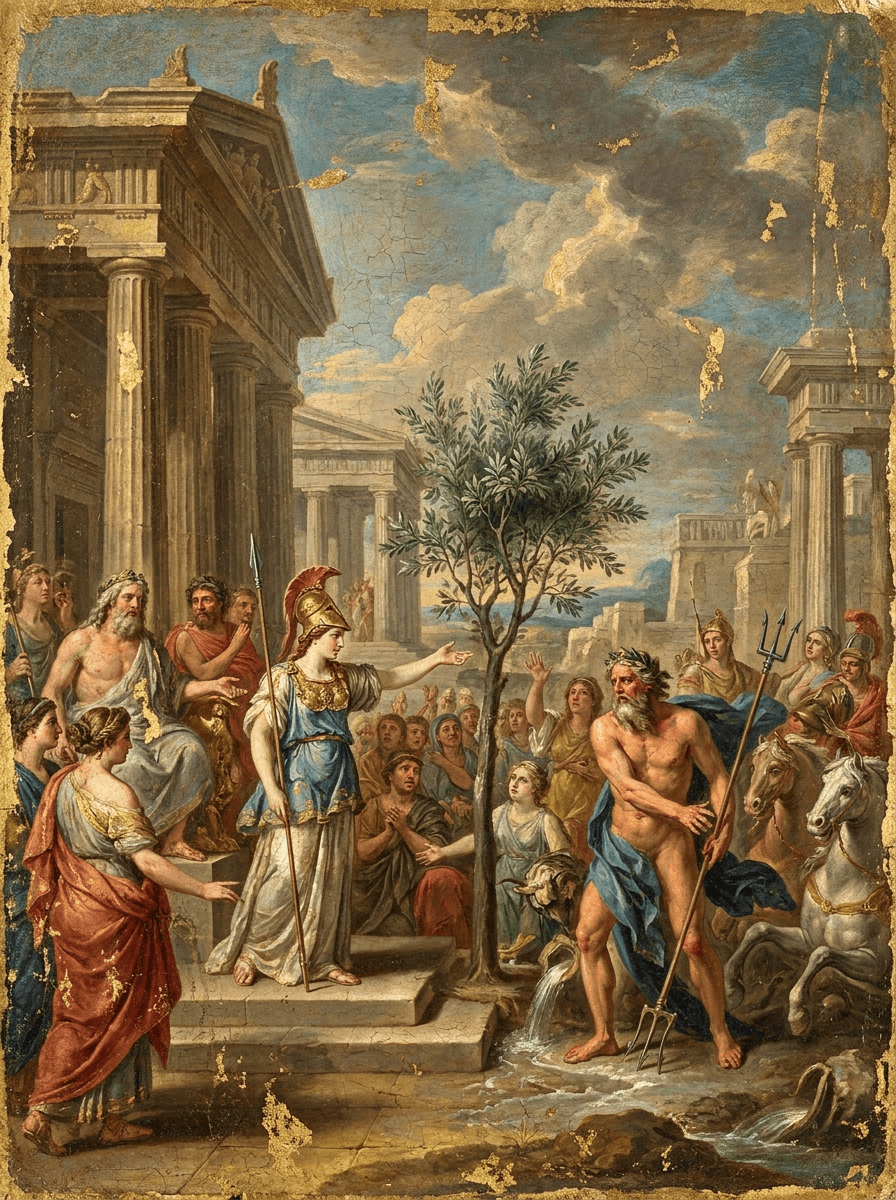
Poseidon and Athena both wished to become the guardian deity of Attica, so each offered a gift before the gods. The sea god struck forth salt water; the goddess planted the olive; and in the end the Athenians chose the tree that could sustain their city for generations.
Article
Summary
Long ago, Attica was a land where hills, shore, and open ground met beneath the sun. Cecrops ruled there, and the people lived among stony slopes and thin soil. They needed the roads of the sea, but they also needed a gift that would make daily life secure. Poseidon came first to claim the land. He raised his trident and split the rock, and water surged from the cleft. The people marveled at the sea god’s power, but the water tasted of salt, as though the sea itself had broken into the citadel. It could not truly quench their thirst. Then Athena planted the olive. A young shoot rose from the poor soil, its silver-gray leaves flashing in the wind. The goddess told the people that the olive would bear fruit, yield oil, feed lamps, heal wounds, and give the city something precious to trade with distant lands. The gods judged Athena’s gift the better one for that country, and the city of Attica took her name and became Athens. Poseidon was displeased by his defeat, yet his power remained along the shore; Athena’s olive tree stayed within the city, becoming the sign the Athenians treasured most.
The Land Beside the Sea
Long ago, Attica was not yet the Athens people would later know. It was a country of rocky hills, sea-facing coasts, and patches of land where crops might grow. In summer the sun beat down on pale stone slopes, while wind came in from the Saronic Gulf carrying the salt smell of the sea. People built their homes at the foot of the hills, drove their sheep to graze on the high ground, and scattered seed into the scant earth, hoping autumn would bring a little more grain.
In those days the land was ruled by an early king named Cecrops. Legend gave him a strange shape: above the waist he was a man, below it a serpent, as if half of him belonged to the people of the city and half to the ancient earth beneath their feet. On a high rocky hill he built his stronghold, from which he could see the fields below and the shining sea far away.
The land was not especially rich, but it was well placed. It lay near the water, so ships could come and go. Its hills were easy to defend. And a people was gathering there—people willing to offer sacrifice, and willing to live under the protection of a god. So two great deities set their eyes upon it.
One was Poseidon, lord of the sea. He came riding the waves, foam rolling beside his chariot wheels, sea-horses drawing him out of the deep blue water to the shore. In his hand he held the trident: with one thrust into the sea he could raise the waves; with one blow upon the earth he could split stone.
The other was Athena. She did not arrive on the surf, but descended upon the citadel like the light of morning. She wore a helmet, carried a spear, and her shield flashed in the sun. Her eyes were bright and calm, as though they could see both the battlefield and the loom, the carpenter’s axe and the farmer’s plow.
Both deities declared, “This city should be under my protection, and it should be honored by my name.”
When they heard this, the people of Attica did not dare answer lightly. If the sea god grew angry, ships could capsize and the coast could be shattered by great waves. If Athena was offended, courage and clear thought might depart from the city. So they brought the dispute before higher judgment. The gods gathered on Cecrops’ citadel, seated themselves on the heights from which the sea was visible, and waited to see what gifts the two great powers would offer the land.
The Rock Split by the Trident
Poseidon stepped forward first.
He stood upon the rock, the sea wind stirring his hair and beard, while the ground beneath him seemed to hear the sound of the tide. The people of the city gathered at a distance, not daring to come too near. Cecrops stood before them all and watched the sea god raise his trident.
Poseidon said little. He drove the trident hard into the rocky earth.
A deep crash sounded, like thunder rolling underground. The hard stone split open, and water poured from the crack—first in a single rush, then gathering into a small spring. Spray leapt across the rock and glittered in the sunlight. The people cried out in wonder, for on the dry hills of Attica, water had suddenly burst from stone. It seemed a miracle.
Poseidon looked upon them and declared this to be his gift. Whoever enjoyed his protection would have the roads of the sea: ships, harbors, and the wealth of distant places. The waves would carry people to other cities, and bring the goods of other cities back again. If he wished it, horses too would run for this land, and chariots would raise dust across its plains.
The people drew near to the spring and bent to taste it. But as soon as the water touched their tongues, they frowned. It was not the sweet water of a mountain spring. It carried the salt of the sea. It proved Poseidon’s power, but it could not make fields green, nor could it give a thirsty child safe drink.
Yet no one laughed. Everyone knew that a god who could crack rock and make seawater rise upon a hill was not to be treated lightly. Many also understood that Attica lived by the sea; with the sea god’s favor, ships might enter and leave more safely, and fishing nets might come back fuller. So the people remained silent and turned their eyes toward the other goddess.
The Goddess Plants the Olive
Athena went to a patch of bare earth beside the rocky hill.
There was no deep black soil there, only shallow dust and broken stone. She set her spear beside her, bent down, and, like someone who truly understood the temper of the land, placed a seed in the ground. Some traditions say instead that she touched the earth gently with the point of her spear. Whichever way it was told, in that moment everyone saw the earth answer her.
The soil stirred and rose. A small green shoot pushed up beside the stones. It grew swiftly; slender branches opened, and leaves unfolded one by one. The upper sides were green, the undersides silver-gray, and when the wind passed through them the whole tree seemed to shine. Before long an olive tree stood beside the citadel. Its trunk was not yet thick, but it was firm, as though it had belonged to that land from the beginning.
Athena pointed to the tree and told Cecrops and the people that this was her gift.
It had not appeared with the roar of Poseidon’s spring, but it would grow year after year. Its fruit could be pressed for oil. That oil could feed lamps, soothe wounds, anoint athletes, and be poured into clay jars to trade with people far away. Its wood was hard and useful for making tools and household things. It could endure drought and poor hillsides. If people cared for it, it would take root even in stony ground.
The people looked at the tree, and little by little they knew the answer in their hearts.
What Attica lacked was not only astonishing power. Its people had to live. Their children had to grow. The altar needed fire, the house needed light, and ships needed jars of oil to carry overseas. Poseidon had given them the majesty of the sea; Athena had given them a lasting way of life.
But such a choice could not be made merely by sudden liking. Both great deities were present, and so were the gods. Cecrops had to be careful. He examined the spring and the olive tree, then explained all that stood before him to the divine assembly. At last the judgment was given: the land should be guarded by Athena, because her gift was the more beneficial to the city.
The City’s Name
When Poseidon heard the decision, his face darkened.
The sea god was not one to forget an offense easily. His trident could raise storms and make the earth tremble. The people of Attica had chosen Athena, and that meant he had been defeated before the gods. He looked at the rocky hill, then at the newly grown olive tree, and the wind from the sea suddenly turned cold.
Some traditions say that in his anger Poseidon made the waters rise and flooded part of Attica. Others say only that he left behind the salt spring and the mark of his trident on the rock, so later generations would never forget that he too had come to claim the place. In either case, the people never dared forget the sea god. The Athenians would still sacrifice to Poseidon, for though their city belonged to Athena, it could not live without the sea.
But the city’s name was given to Athena.
The people called it Athens and honored the goddess as their closest protector. She was not only a deity of the battlefield; she also watched over craft, counsel, and courage within the city. The olive tree on the hill became her sign, its leaves turning silver in the wind like the goddess’s silent answer.
In later times, when people climbed the Acropolis, they still spoke of the day when two great deities contended for the land. They said the rock had once borne the print of the sea god’s trident, and that salt water had welled up there. They also said that Athena’s olive grew within the city, and that even after disaster, if its root remained, new branches would rise again.
So the contest did not end with swords, nor did it make one god vanish from the land. Poseidon’s sea still beat against the shore beyond the city, but Athena’s tree took root within it. When the Athenians looked up and saw the Acropolis, looked down and saw the olive, or gazed outward and saw the sea, they knew their city had always stood between the powers of two great gods. And the gift they chose to remember was the tree that bore fruit, gave light, and nourished the years.