Greek Mythology
Crete — Greek Mythology
Crete is an important island in Greek mythology, surrounded by the sea and linked to Zeus’s birth, Europa’s arrival, Minos’s court, and the labyrinth tradition. It is both the hiding place of the young king of the gods and a central setting in stories about Cretan kingship, the Minotaur, and Daedalus.
Overview
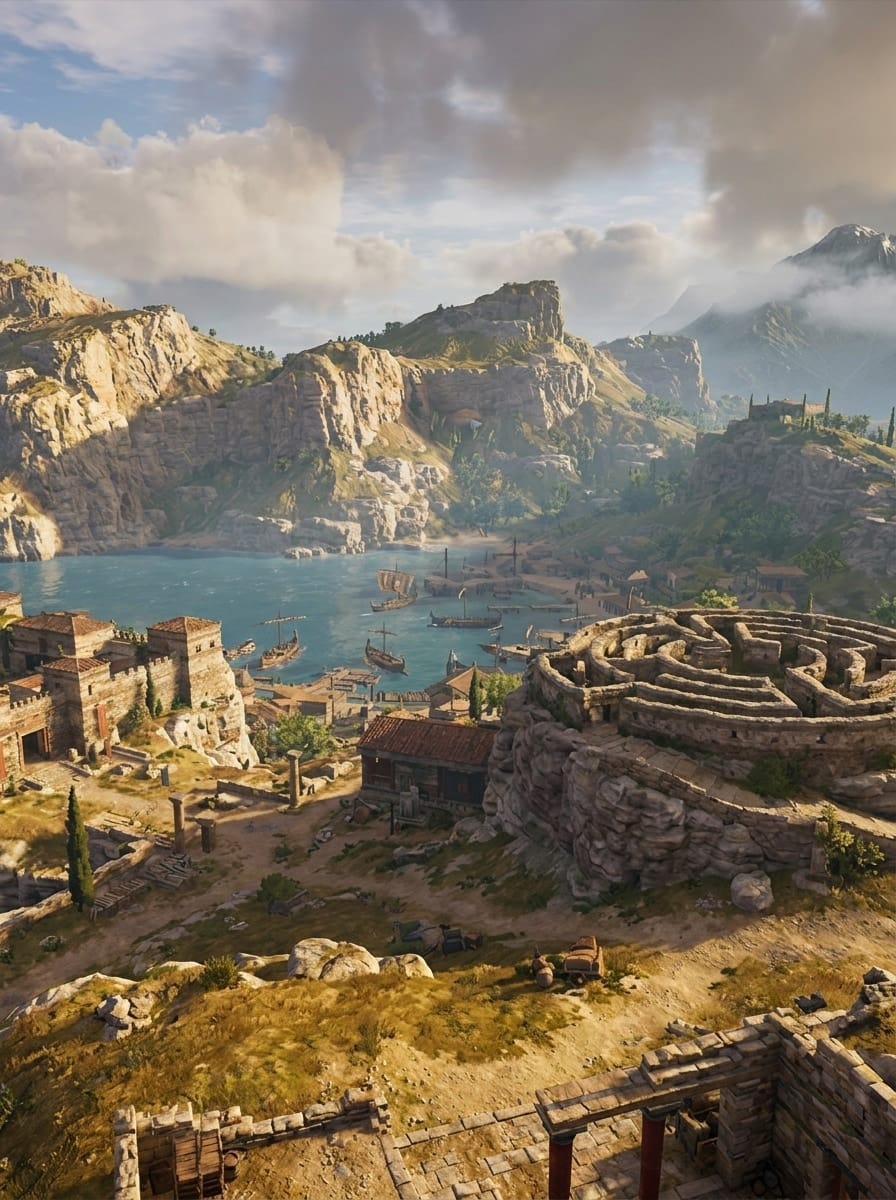
In mythic geography, Crete is shown as an island set apart from Cronus’s sight and ringed by the sea, with mountains, caves, woods, coasts, and royal palaces. Europa is brought here from the Phoenician coast by Zeus, and Daedalus later flees to the island from Athens before trying to escape from it by flight.
Article
In Greek mythology
Crete is first of all the refuge of Zeus’s childhood. Rhea, following Gaia’s guidance, hid the newborn Zeus in a cave on Crete and deceived Cronus with a stone wrapped in swaddling clothes; later Titanomachy traditions also connect Zeus’s growth with the island.
Crete is also the destination in the Europa myth. Zeus took the Phoenician princess Europa away in the shape of a white bull and crossed the sea to the Gortyn area of Crete. Europa gave birth on the island to Minos, Rhadamanthys, and Sarpedon, making Crete the starting point of several royal and heroic lineages.
In traditions about King Minos, Crete is the center of the palace, labyrinth, and Minotaur stories. After fleeing Athens, Daedalus was sheltered by Minos and built the labyrinth on Crete; the Minotaur was confined deep inside it, and Theseus later entered the labyrinth to kill the monster and escape with Ariadne and the thread.
Geography and natural setting
The Crete of myth is often framed by mountains, caves, coasts, and royal palaces. The scenes of Zeus’s birth and hiding center on mountain caves, with rock walls, cave mouths, slopes, trees, and bees; these details emphasize the island as a hidden refuge.
In the Europa story, Crete emerges from the sea, with mountains in the distance and stone beaches and tree shadows along the shore. The Gortyn area is described as having springs and trees; it is the place where Zeus and Europa meet and where Europa remains on the island.
In Daedalus traditions, Crete combines courtly and maritime features. Minos’s palace has steps, courtyards, columns, altars, and storehouses, and sea winds can enter the portico; the island’s coasts have sea routes and ports, and once Minos controls the ships, Daedalus and Icarus turn to the sky in their escape.
Historical and religious landscape
Crete also preserves traces as a place of sacred objects and ritual traditions. In Tantalus, a temple of Zeus on Crete contains a golden dog, which is later stolen and becomes part of the wider tradition of Tantalus’s crime.
In Apollo and Python, after establishing the sanctuary at Delphi, Apollo directs a ship from Crete to change course and sends the crew to serve him at his new sanctuary below Mount Parnassus. This links Crete with the priestly tradition of Delphi, though the main setting of the episode remains Delphi.
Related stories
In Cronus Devours His Children, Rhea, following Gaia’s guidance, comes to Crete and gives birth to Zeus in a cave, hiding him there.
In The Birth and Rescue of Zeus, Zeus is protected in a cave on Crete by nymphs, Amalthea, and the Curetes, and later grows up to confront Cronus.
In The Titanomachy, Zeus grows up on Crete, then frees his siblings and goes to war with the Titans.
In Zeus and Europa, Zeus, in the shape of a white bull, carries Europa from Phoenicia to Gortyn on Crete, and Europa gives birth to Minos and his brothers on the island.
In Daedalus and Icarus, Daedalus comes to Crete to serve Minos, builds the labyrinth, and later flies away from the island with Icarus.
In Apollo and Python, Apollo sends sailors from Crete on to Delphi and has them serve as priests of the sanctuary.
In Tantalus, the temple of Zeus on Crete and the golden dog become part of the tradition of Tantalus’s crime.