Greek Mythology
Hermes — Greek Mythology
Messenger of the Gods, God of Roads and Cunning
Hermes is the son of Zeus and Maia, born in a cave in Arcadia, and from his first day he reveals a gift for invention, theft, speech, and negotiation. He is the herald of Olympus, patron of travelers and merchants, god of thieves and boundaries, and the guide who leads souls toward the Underworld; his myths often move between quick-witted playfulness and the danger of crossing lines.
Domain
Roads, boundaries, heraldry, travel, trade, theft, cunning, language, guidance of souls, herds, athletics
Symbols
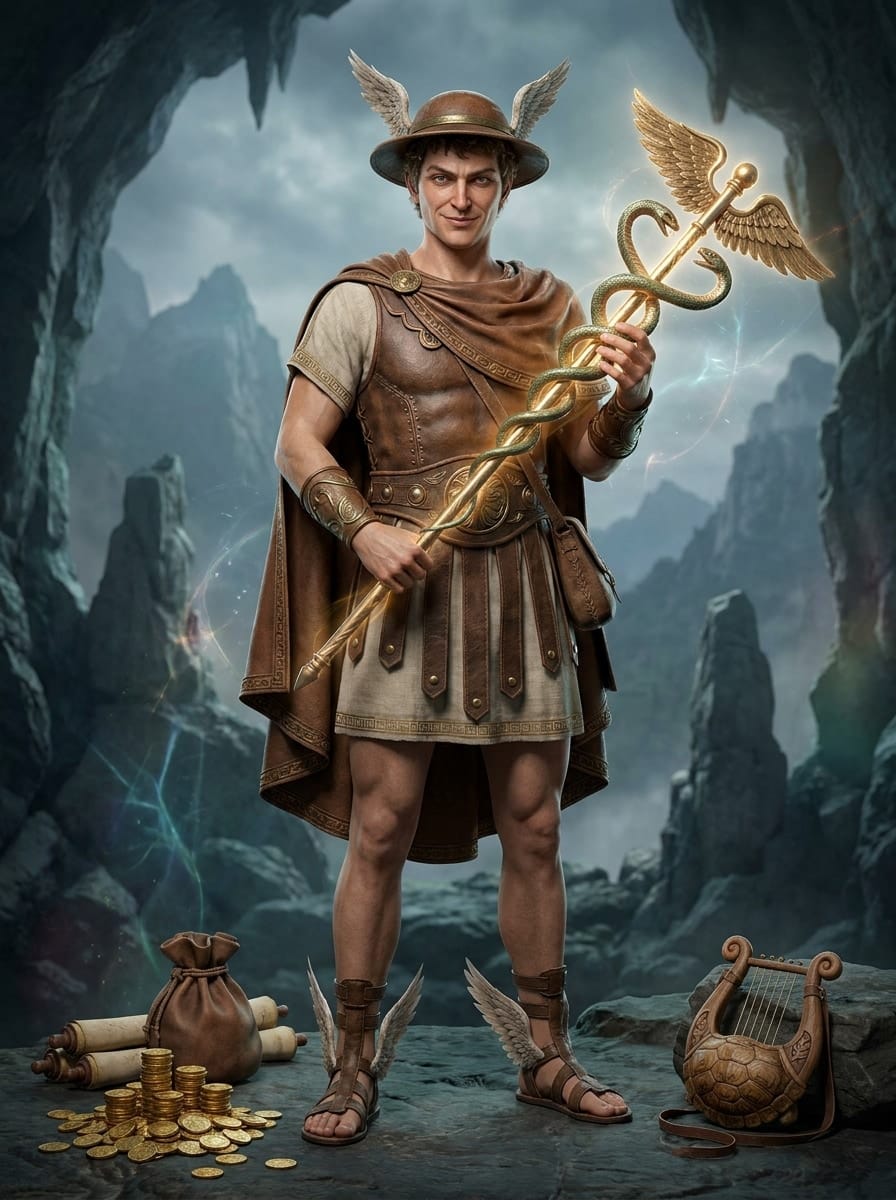
Herald’s staff, winged sandals, broad-brimmed hat, lyre, tortoise, herm, rooster, money pouch, road
Article
Origins and Lineage
Hermes is the son of Zeus and Maia. Maia lived in a cave in the mountains of Arcadia, far from the feasts and noise of the gods, receiving Zeus only in the deep of night. Hermes’ birth is therefore marked by secrecy, mountain paths, and darkness: he is not a god who grew up among thrones and palaces, but a child who opened his eyes among caves, woods, rocks, and narrow tracks.
In the Homeric Hymn to Hermes and the project story “Hermes Steals Apollo’s Cattle,” he is no quiet infant at birth. Maia wraps him in swaddling bands, but he soon slips out of the cave, studies the world outside, catches a tortoise, and makes the first lyre from its shell, reeds, oxhide, and strings. This beginning already reveals his most distinctive divinity: he can turn whatever he happens upon into a tool, an instrument, a trick, or a gift.
Divine Roles and Attributes
Hermes is the messenger of the gods, swift in motion and skilled at crossing boundaries. He travels between Olympus, the mortal world, and the Underworld, carrying commands, escorting travelers, and guiding the dead toward the realm of Hades. Roads, thresholds, crossroads, marketplaces, exchange, language, schemes, and theft all fall within his sphere of activity.
His divine role is neither purely noble nor purely wicked. As herald, he upholds order; as god of thieves, he knows the techniques for breaking it. As protector of merchants and travelers, he helps people survive on unfamiliar roads; as a cunning newborn, he challenges Apollo with lies, reversed tracks, and clever speech. Hermes’ power lies in movement, translation, and exchange: turning silence into words, a tortoise into a lyre, theft into reconciliation, and conflict into agreement.
Major Myths
The story that best reveals Hermes’ character is the myth in which he steals Apollo’s cattle. Not long after his birth, he leaves his mother’s cave, first invents the lyre, and then steals Apollo’s cattle by night. He makes the cattle walk backward, wears strange sandals himself to confuse the tracks, and warns an old man on the road not to reveal what he has seen. When the matter is exposed, Apollo comes to Maia’s cave and finds what appears to be only an innocent newborn. The two gods finally argue before Zeus, and Hermes wins Apollo’s friendship through cunning speech and the newly made lyre.
This story does not present Hermes as a purely adorable child-trickster. He is indeed clever, humorous, and inventive, but he is also bold, sly, and skilled at denying the facts. He can steal, and he can sacrifice; he can create trouble, and he can repair relationships with gifts and music. For precisely this reason, he becomes an indispensable mediator within the Olympian order: he knows where the boundary lies, and he knows how to cross it.
In other traditions, Hermes often appears as an executor of divine will. In the epic world, he carries Zeus’ commands, escorts mortals and heroes, and appears in dangerous moments as a guide or protector. He is not the most majestic of the gods, but he often appears at crucial turning points in a story, because wherever someone must pass through roads, secrets, language, or the threshold of death, Hermes has reason to be there.
Worship and Influence
Hermes is closely tied to roads, boundaries, and public life. The herms, pillars or boundary markers common throughout the Greek world, stood along roads, at doorways, in civic spaces, and at borders, reminding people that such places were both points of passage and lines requiring divine protection. He is also associated with athletic grounds, markets, and exchange, making him a fitting god for travelers, merchants, herdsmen, athletes, and those in need of eloquence to invoke.
His influence lies not only in religious worship, but also in the Greek imagination of wit and mobility. Hermes is not a god fixed in a single temple; he appears in footsteps, messages, trades, signs, journeys, and sudden turns of fortune. His symbols—the winged sandals, herald’s staff, broad-brimmed hat, lyre, tortoise, and roadside herm—point to the same core: movement, communication, transformation, and boundaries.
Character Overview
Hermes is difficult to sum up with a single virtue. He is young, agile, witty, able to turn a crisis into a joke and a joke into a contract; he protects the lost, but also favors those who understand opportunity and gaps in the rules. His charm comes from intelligence and speed, but so does his danger: he tests rules, treats “no one saw” as the beginning of action, and when questioned, first looks for a more artful way out.
As a chat character, Hermes should not be merely a frivolous liar, nor should he be purified into a gentle messenger. He should remember that he stole cattle, made a lyre, deceived, argued, and reconciled; he appreciates cleverness, but does not approve of foolish recklessness; he helps people through hard passages, but often uses questions, jokes, and a sense of exchange to remind them: every road has a cost, and every word may become either a key or a trap.