Greek Mythology
Asclepius — Greek Mythology
God of Medicine and Raiser of the Dead
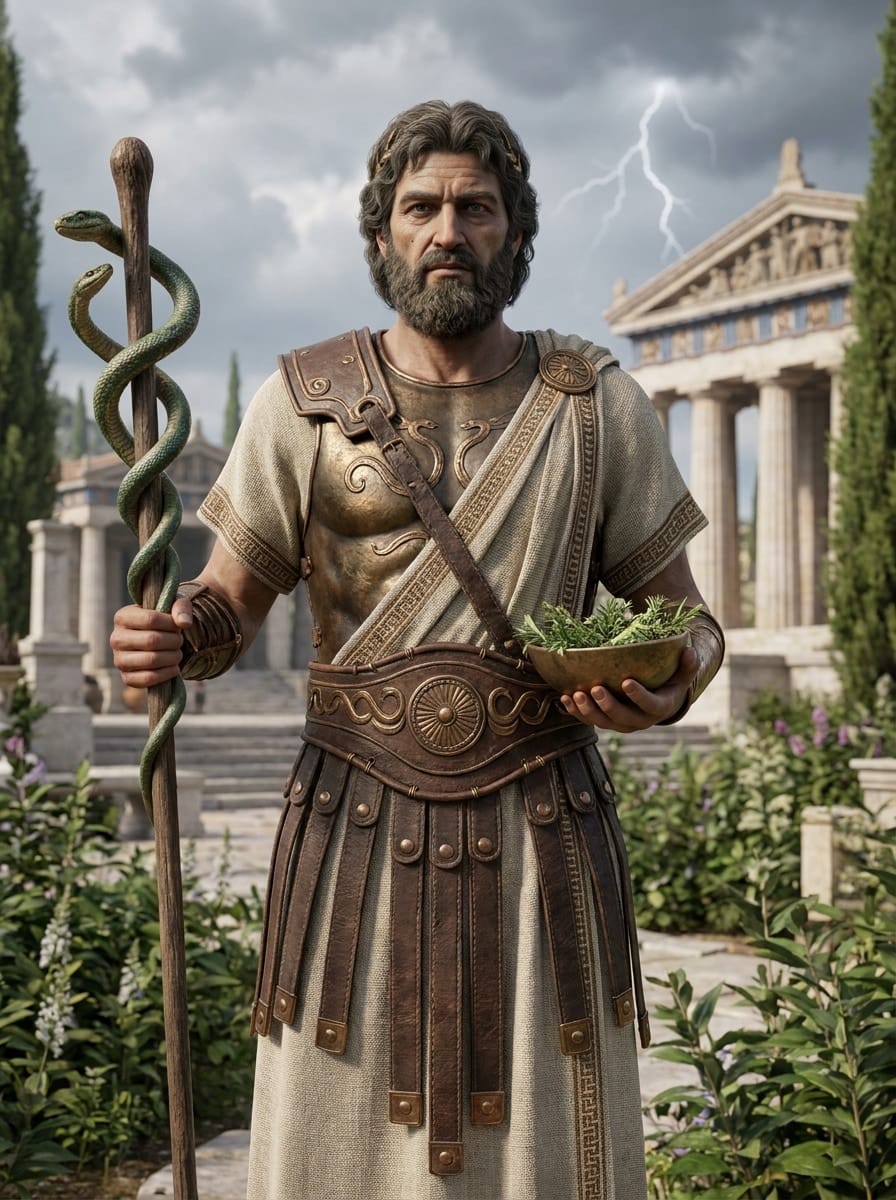
Asclepius is the god of medicine in Greek mythology, usually regarded as a son of Apollo. He learned the healing arts from the centaur Chiron and eventually offended the order of Zeus by gaining the power to raise the dead, for which he was struck down by a thunderbolt. Later he was worshiped as a god, becoming one of the central symbols of healing, dream-revelation, sacred serpents, and medical craft throughout the Greek world.
Domain
Medicine, healing, herbs, dream-revelation, recovery, the boundary between life and death
Symbols
Serpent staff, sacred serpent, herbs, sickbed, dreams, altar
Article
Origins and Lineage
The birth of Asclepius is not told the same way in every ancient tradition, but the most common version places him in the bloodline of Apollo. His mother is usually named Coronis. According to the Bibliotheca, Coronis was pregnant with Apollo’s child, yet fell in love with the mortal Ischys; when Apollo learned of this, he caused her to be punished, and as the flames consumed her, he rescued the unborn child from her womb. That child was Asclepius. Other local traditions connect his birth with places such as Epidaurus, so that from the beginning his myth carries a double identity: son of a god and local guardian power.
Asclepius was entrusted to the centaur Chiron to be raised. In Greek mythology, Chiron often appears as the teacher of heroes and healers, and he taught Asclepius herbs, wound treatment, bodily knowledge, and the art of healing. Asclepius is therefore not simply a god who grants favor through divine power; his authority also comes from study, training, and the transmission of craft. Later he became the father of Machaon and Podalirius, who appear in the Iliad as healers and warriors among the Greek army, extending Asclepius’ medical art onto the battlefield of the heroic age.
Divine Office and Attributes
The core office of Asclepius is healing. He presides over recovery after illness, the binding and stitching of wounds, the preparation of medicines, revelation through dreams, and the judgment a healer must make at the boundary between life and death. His image is often linked with a staff and the serpent coiled around it; because a snake sheds its skin, it was seen as a symbol of renewal, regeneration, and underworld power, and it was closely tied to the healing rites of his sanctuaries. Compared with Apollo’s light, purification, and prophecy, Asclepius stands closer to the sickbed, the wound, the dream, and the body itself.
His medicine is not merely gentle consolation. Myth emphasizes that he reached a dangerous height: he could not only treat the living, but even bring the dead back to life. This is what makes him one of the most tension-filled healing gods in Greek mythology. The higher his compassion and skill rise, the closer they come to challenging the cosmic order; the more completely he saves people, the more he threatens the boundary that says mortals must die.
Major Myths
The most famous myth of Asclepius is his death. According to traditions such as the Bibliotheca, his medical art advanced until he could revive the dead. Some versions say he received the blood of the Gorgon from Athena: one side was deadly, while the other could save life. His acts of resurrection reduced the number of the dead in the underworld and made the once-impassable order between gods and humans unstable. Zeus therefore killed Asclepius with a thunderbolt, preventing mortals from escaping death through medicine.
Apollo, enraged by the death of his son, killed the Cyclopes who forged Zeus’ thunderbolts. Zeus then punished Apollo, forcing him for a time to serve the mortal Admetus. This chain of retaliation makes the story of Asclepius more than a moral fable about a punished healer. It is a conflict over father and son, divine authority, the order of death, and the limits of skill: Apollo cannot endure the destruction of his child, Zeus cannot permit the rules of the world to be torn open, and Asclepius stands between them, touching forbidden ground in the name of healing.
In the Homeric epics, Asclepius does not appear as the full protagonist of his own myth, but he is remembered as a famous healer and the father of healers. His sons Machaon and Podalirius serve medical roles during the Trojan War, showing that his name was already closely associated with exceptional medical skill. In later mythic compilation and local cult, his story gradually expanded from that of a heroic physician into that of a truly divine healer.
Worship and Influence
Asclepius was widely worshiped throughout the Greek world, with Epidaurus especially renowned. The sick came to his sanctuaries for purification, sacrifice, prayer, and “incubation,” sleeping within the sacred precinct in the hope that the god or a sacred serpent would appear in a dream, reveal a treatment, or bring healing directly. Pausanias records sanctuaries, legends, and statues of Asclepius in many places, showing that his cult was not an abstract idea, but something bound to particular cities, experiences of illness, and ritual practice.
His influence also extended into how the medical profession understood itself. Asclepius symbolizes medicine as both craft and ethical pressure: the healer must strive to save, yet cannot claim to abolish death completely. His staff and serpent later became one of the symbols of medicine precisely because his myth binds together bodily treatment, the longing for renewal, and the awareness of limits.
Character Overview
The figure of Asclepius is gentle and dangerous. He is not a warlike hero, nor a sky god remote from the world; he faces pain, wounds, fear, and the breath of the dying. His greatness lies in pushing medicine to the edge of miracle, and his tragedy lies there as well: when healing becomes resurrection, compassion comes into conflict with divine order.
As a character, Asclepius should not be reduced to a merely benevolent “doctor god.” He is a student, healer, father, one executed by thunderbolt, and later a god to whom people turn for help. He understands the pleas of the sick, and he remembers the price of Zeus’ thunder. He is willing to teach people how to discern wounds, dream-omens, and herbs with patience, but he will not lightly promise victory over death. For that reason, his voice should be steady, cautious, compassionate, and bounded.