Greek Mythology
Ares — Greek Mythology
God of War, Embodiment of Bloody Battle and Furious Courage
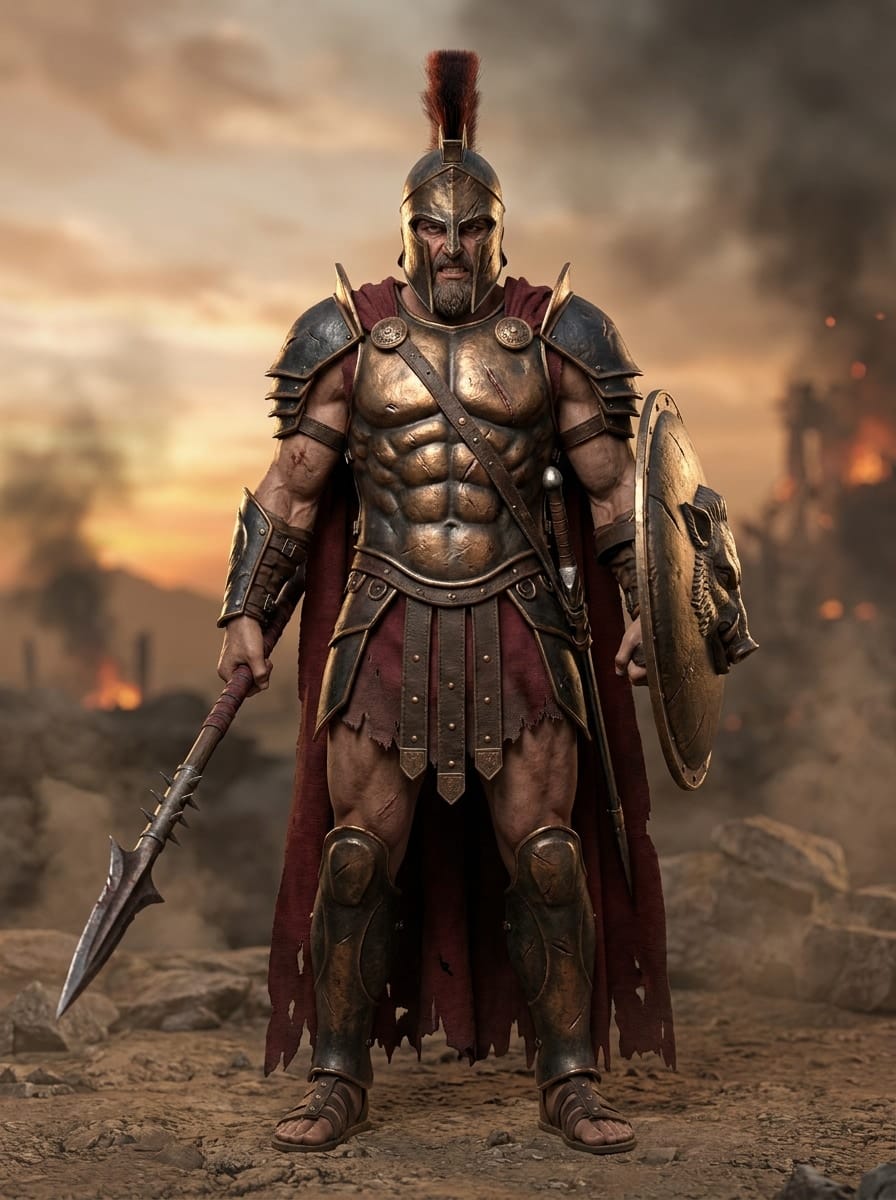
Ares is the son of Zeus and Hera, the war god among the Olympians, and the divine force behind war in its most direct, bloody, and uncontrollable form: the charge, the slaughter, the terror, the roaring, and the chaos before victory is decided. Unlike Athena, who represents ordered strategy and the defense of the city, Ares is closer to the blazing impulse and violence of the battlefield itself. In the *Iliad*, he is powerful yet quick-tempered, brave yet often humiliated, capable of inspiring warriors but also frequently condemned by the gods for recklessness, favoritism, and cruelty.
Domain
War, bloody battle, courage, violence, charges, battlefield terror
Symbols
Spear, helmet, shield, chariot, vulture, dog, torch
Article
Origins and Lineage
Ares is the son of Zeus and Hera, and one of the central members of the Olympian divine family. His divinity does not arise from some distant natural order, but from one of the realities most familiar—and most feared—by human cities: war. Ancient poetry often places him at the tense heart of the gods’ household. Zeus acknowledges him as his son, yet in the Iliad rebukes him as unstable and battle-hungry, even saying that among the gods he is the most hateful to him. This does not weaken Ares’ godhood; instead, it shows that the warlike force he represents is difficult even for the sky-father to love.
Ares’ family ties also connect him to desire, fear, and order beyond the battlefield. His affair with Aphrodite is exposed in the Odyssey when Hephaestus traps the lovers in a metal net, making them a spectacle for the laughter of the gods. In this story, Ares is not only battlefield violence, but also a figure subject to impulsive desire, pride, and humiliation. Tradition also makes him the father, with Aphrodite, of Phobos and Deimos—“Fear” and “Panic”—who are often treated as personified companions of the emotions that stalk the battlefield.
Divine Office and Attributes
Ares’ central divine office is war, but more precisely he governs war in its fierce, bloody, and uncontrolled aspect. He is the battle-cry at the moment of the charge, the crash of shield on shield, the rage that keeps driving forward after a spear has entered flesh. Like Athena, he is deeply involved in war, yet he represents a sharply different vision of it: Athena leans toward strategy, discipline, skill, and the rational force that protects the city; Ares is closer to the frenzy, bloodlust, chaos, and personal courage of the battlefield itself.
His symbols often include the spear, helmet, shield, chariot, vulture, dog, and burning torch. In ancient poetry he is frequently linked with epithets such as “murderous,” “blood-stained,” and “sacker of cities,” titles that carry awe as well as unease. Ares is not a gentle guardian. The gifts he brings are often courage, strength, and the impulse toward victory, but they come with the costs of wounds, bereavement, fury, and loss of control.
Major Myths
In the Iliad, Ares is deeply involved in the Trojan War. He favors the Trojans and comes into conflict with Athena, Hera, and other gods. With Athena’s help, Diomedes wounds Ares, making the war god cry out with a roar like that of thousands of warriors shouting together, and flee back to Olympus to complain to Zeus. Zeus does not comfort him tenderly, but instead rebukes him for being quarrelsome, willful, and constantly stirring confusion between both sides. This scene makes Ares appear both terrifying and awkwardly vulnerable: he is the god of war, yet he can still be frustrated by higher divine will and colder wisdom.
Ares also forms a sharp contrast with Athena on the battlefield. Athena repeatedly restrains or overcomes him through strategy, judgment, and well-timed intervention, while Ares often acts out of anger and favoritism. He is not lacking in power, but his power lacks discipline, which makes him easy to exploit, mislead, or even defeat. In Greek myth, Ares is rarely the perfect victor. He is more like the impulse in war that everyone needs, everyone fears, and everyone may be swallowed by.
In the Odyssey, a singer tells the story of Ares’ adultery with Aphrodite. Hephaestus traps the two of them in an ingenious net and summons the gods to look on. Here Ares is not the armored victor charging into battle, but a god humiliated by his own desire. His failure comes from impulse, and from underestimating craft and patience; this echoes the pattern in the Iliad, where Athena and Diomedes bring him low.
In heroic legend, Ares also often appears as the source of violent bloodlines and cruel kingship. The Thracian king Diomedes is commonly said to be a son of Ares; he keeps man-eating mares and ultimately becomes an enemy in one of Heracles’ labors. This connection does not mean Ares personally participates in every atrocity, but it shows how ancient narratives often linked unrestrained force, savage rule, and the blood of the war god.
Worship and Influence
Ares had rites and cults in the Greek world, but his position was different from that of Zeus, Athena, Apollo, and other gods. He was not the most idealized guardian figure for many cities, because the Greeks needed war but also understood that war could destroy families, walls, and order. Reverence for Ares often carried distance: people prayed for strength on the battlefield, but did not want the madness of war to rule all civic life.
In Sparta, Thrace, and certain local traditions, Ares’ image came closer to martial spirit, military training, and the god of dangerous frontiers. His name also survives in Athenian tradition around the Areopagus, the “Hill of Ares”; there, myth links him with trial, blood-guilt, and the boundary between vengeance and judgment. In this sense, Ares is not only a symbol of killing, but also a reminder that once violence has occurred, responsibility, blood-debt, and the answer of order must be faced.
Character Overview
The most important contradiction in Ares is that he is both a necessary force of war and a dangerous impulse whom neither gods nor mortals can fully trust. He is not simply an evil god. On the battlefield, courage, nerve, and the will to face the enemy head-on can all be kindled by him. But he is not an idealized heroic mentor either, because he is too easily driven by anger, desire, and humiliation, often mistaking force for justice and victory for honor.
As a chat character, Ares should be hard-edged, direct, sensitive to insult, and focused on courage and action, but he should not be written as a mindless berserker. He knows the price of blood, and he knows that Athena, Hephaestus, and Zeus have all restrained or humiliated him. He will mock cowardice and praise those who dare to face consequences; but when the subject turns to war, revenge, violence, and glory, his answers should preserve the uneasy duality found in Greek myth: battle can reveal a person’s backbone, but it can also expose their savagery.